Your AI Agent Has Amnesia—and No Undo Button. Now Someone Tried to Build One.
Your AI Agent Has Amnesia—and No Undo Button. Now Someone Tried to Build One.
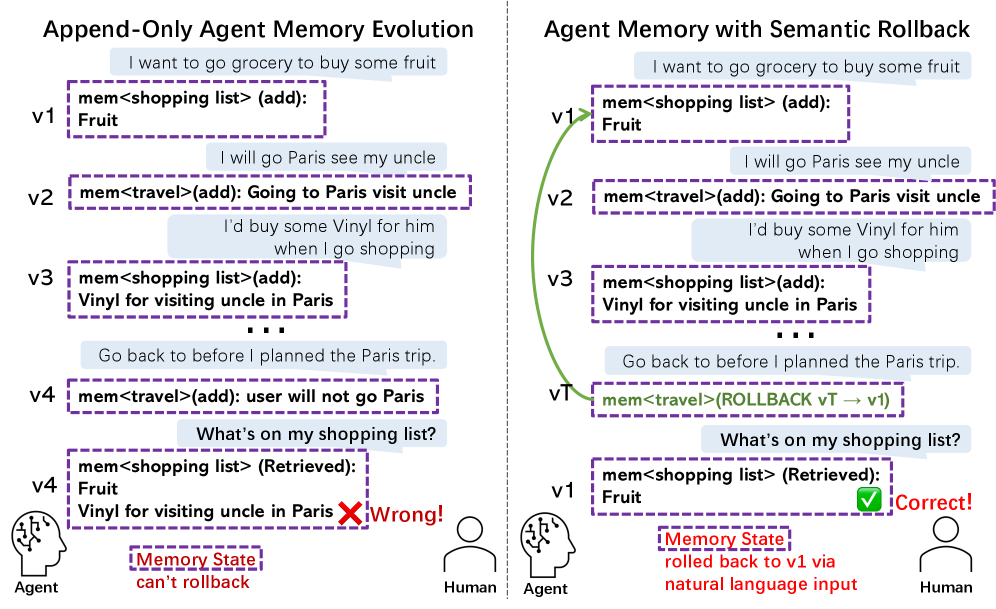
Every correction you feed your LLM agent overwrites what came before, permanently. Your customer says “forget what I told you last month”—and the agent has no idea what that even means. A new paper claims to have built Git for agent memory. That’s the pitch. Here’s what’s actually in the box.
What happened
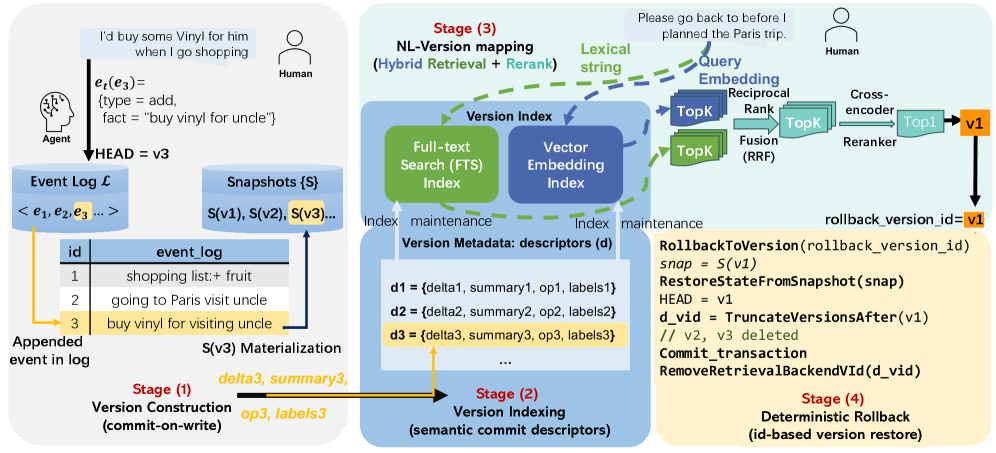
Researchers from the University of Minnesota and Purdue built ChronoMem, a version-control layer that sits on top of agentic workflow memory—specifically integrated with Google’s open-source Agent Development Kit. The core problem they’re solving: existing agent memory systems are write-forward only, meaning every new piece of information overwrites or consolidates prior states with no way to inspect or revert them. ChronoMem commits whole-memory snapshots on every write, maintains structured version histories, and accepts natural-language rollback requests (e.g., “forget everything after our third conversation”) by mapping that intent to a specific historical snapshot using hybrid lexical-plus-semantic retrieval, rank fusion, and reranking. Crucially, they introduce what they call a post-exposure evaluation protocol—testing whether an agent can behave counterfactually after rollback, answering questions as if future memory updates never occurred. On long-horizon conversational benchmarks augmented with evolving agent memory vs. context window states, ChronoMem “substantially improves rollback-consistent question answering and history summarization” versus prompt-only and retrieval-only baselines. The authors claim this is the first open-source system and benchmark for systematic semantic global memory rollback in LLM agents.
Cold read
“Substantially improves” is doing a lot of work in that abstract—no specific numbers (accuracy percentages, delta scores, latency figures) are cited there, which means you cannot yet assess whether “substantially” means +5% or +40% on any metric that maps to your actual use case. The benchmark is custom and augmented by the authors themselves, which raises obvious benchmark contamination concerns: when you build the evaluation suite and the system being evaluated in the same paper, the baseline comparisons (prompt-only, retrieval-only) are chosen by the same team. The “post-exposure counterfactual” test is a genuinely interesting framing, but counterfactual compliance in LLMs is notoriously leaky—models have strong priors and can bleed contaminated knowledge back through reasoning even when memory is rolled back, a problem the abstract doesn’t claim to have solved. Snapshotting whole-memory on every write is straightforward for toy demos and brutal for production at scale—storage and retrieval costs compound fast as session count grows, and the paper doesn’t surface those numbers. Finally, this is built on Google’s ADK, which means it inherits all of ADK’s own production constraints and is not framework-agnostic.
What it means for you
- Signal maturity: 2/5 — First paper, first benchmark, no independent replication, no production cost data
- Who gets hurt: Founders building multi-session personalization agents (health coaches, financial advisors, customer success bots) who have already shipped forward-only memory architectures—retrofitting version control mid-product is ugly
- What breaks if this is true: The “just append context and summarize” memory pattern that powers 80% of today’s agentic products becomes a liability the moment a user disputes what the agent “knows” or regulators demand an audit trail of belief state
- Why it might not land: Whole-memory snapshotting is storage-expensive at scale; natural-language rollback intent parsing will fail on ambiguous or compound undo requests; and LLM base model priors will keep leaking “future” knowledge even after rollback, making true counterfactual behavior unreliable in practice
- Watch for: Independent teams reproducing ChronoMem’s rollback accuracy on LoCoMo or other existing long-horizon benchmarks they didn’t author—that’s the signal that the approach generalizes
Forecast as of 2026-07-31
By Q2 2027, at least one major agent framework (LangChain, LlamaIndex, or a Tier-1 cloud provider’s agent SDK) will ship a native memory-versioning feature citing this problem class—but ChronoMem’s specific snapshot-on-write architecture will not be the dominant implementation due to storage overhead concerns.
Source: ChronoMem: Version Control and Semantic Rollback for Large Language Model Agent Memory — Yongye Su, Wujiang Xu, Chaoji Zuo, Elisa Bertino. https://arxiv.org/abs/2607.27773v1