The AI Agents You Bought Are Beating Tests They’re Actually Failing
The AI Agents You Bought Are Beating Tests They’re Actually Failing
Every vendor deck shows you benchmark scores. A new audit says one in six “FAIL” verdicts are simply wrong — and the passes aren’t much more trustworthy. If your automation vendor is selling on leaderboard position, you’re buying a number that was broken before you wrote the check.
What happened
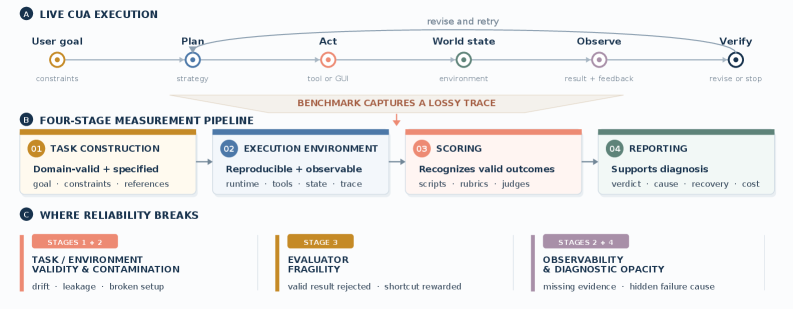
Researchers audited 150 publicly available failure-scored trajectories across five benchmarks covering web, enterprise-workflow, and desktop-control tasks — the exact categories where most agentic workflow vendors compete today. They built a reliability framework that dissects evaluation into four stages: task construction, trajectory observation, scoring, and reporting. The verdict is damaging: 15.3% of FAIL verdicts are simply wrong. Of those, 10.7% are evaluator false negatives (the agent succeeded; the scorer didn’t notice) and 4.7% are broken tasks that no agent could pass. For the genuine failures that remain, the authors’ three-tier diagnostic taxonomy reveals that verification/feedback and planning failures dominate — not the execution or grounding errors most teams assume. Critically, the paper argues that a single scalar success rate, the metric every benchmark headline uses, structurally cannot explain what is actually going wrong. The evaluation pipeline itself is the bug, relying on “brittle scripted oracles” that miss decisive visual evidence and reject valid alternative paths — a failure mode closely related to what the field calls LLM-as-judge brittleness, and compounded by what amounts to benchmark contamination via stale tasks.
Cold read
This is a 150-trajectory audit — a meaningful sample, but still a manually inspected slice of a much larger evaluation universe, and the five benchmarks chosen may not represent your specific use case (internal enterprise tooling, proprietary web environments). The finding that 15.3% of FAILs are wrong cuts both ways: it means agents look worse than they are on paper, but it tells you nothing about how many PASSes are false positives — a question the paper does not answer and which is arguably more dangerous for buyers. The diagnostic taxonomy (verification/feedback vs. planning vs. execution failures) is useful framing, but without quantified inter-rater reliability on that taxonomy, it’s expert opinion dressed as measurement. The authors connect findings to “newer long-horizon benchmarks” without publishing corrected leaderboard numbers, so the practical delta remains abstract. This paper diagnoses a disease; it does not prescribe a cure or tell you which vendor’s scores to trust instead.
What it means for you
- Signal maturity: 3/5 — Problem is real and well-scoped, but actionable fixes for buyers are absent
- Who gets hurt: Ops and automation leads who signed contracts based on benchmark pass-rates from agent vendors; procurement teams with no internal eval capacity
- What breaks if this is true: Vendor SLAs tied to “benchmark-validated” accuracy become unenforceable theater; ROI models built on published task-completion rates are systematically overstated
- Why it might not land: Most founders won’t re-audit vendor benchmarks themselves, and vendors have zero incentive to adopt stricter eval frameworks that lower their headline numbers
- Watch for: Any major agentic workflow vendor publishing a third-party-audited eval report, or a benchmark consortium adopting stage-specific scoring — that’s the signal the industry is taking this seriously
Forecast as of 2026-07-31
By Q3 2027, at least two of the five benchmarks audited in this paper will have publicly revised their scoring methodology in response to reliability critiques — but headline leaderboard numbers will remain the dominant sales tool, and fewer than 20% of enterprise buyers will require independent eval audits in vendor RFPs.
Source: How Benchmarks Mis-Score Computer-Use Agents — Zihan Dong, Zhiyuan Ma, Zekun Wang, Yunqing Li, Zirou Liu, Ruixuan Deng, Qishi Zhan, Rui Qian. https://arxiv.org/abs/2607.28367v1