Your LLM Just Got Twice as Sharp for Free — Or Did It?
Your LLM Just Got Twice as Sharp for Free — Or Did It?
A two-person team claims they can slash quantization error during training by exploiting a mathematical symmetry baked into every transformer — no calibration data required, no fake quantization noise, nearly zero overhead. If it holds up, every inference startup pricing on GPU minutes should be nervous. If it doesn’t, it joins a long graveyard of “free lunch” tricks that vanished under production load.
What happened
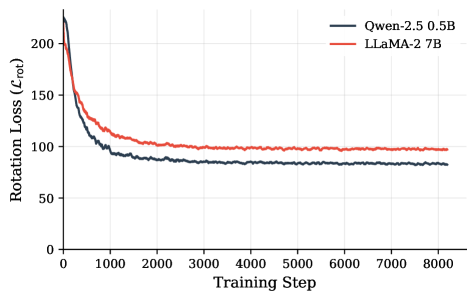
Researchers at (what appears to be a small academic group) discovered that large language models have internal continuous symmetries — essentially, you can rotate the weights in certain ways without changing model outputs, but those rotations do change how badly the model quantizes. GaugeQuant adds a single LogSumExp penalty term to the standard training loss that breaks this symmetry deliberately, steering the model toward a rotation where activation outliers — the main villain in quantization degradation — are minimized. A stop-gradient operator keeps the language modeling objective completely untouched; only the rotation matrices move. The headline numbers on LLaMA-2 7B are striking: under W4A4 quantization with group size 128, perplexity drops from 8.22 to 6.73; under W4A16, from 11.16 to 5.45. The W4A16 result in particular — a 51% perplexity reduction — is the kind of number that makes inference engineers stop scrolling. Code is public on GitHub, which is the minimum bar for taking this seriously.
Cold read
The comparison class matters enormously here: GaugeQuant is benchmarked against post-training quantization (PTQ) methods, not other quantization-aware training (QAT) approaches. Competing with PTQ is a lower bar — PTQ methods are frozen-model, calibration-data workflows that were never designed to match in-training techniques. The abstract says GaugeQuant competes with post-training methods, not that it beats them on every axis; that hedged phrasing should register. This is also tested on exactly one model family (LLaMA-2 7B) at one group size (128) — whether the symmetry argument generalizes cleanly to MoE architectures, longer context windows, or models trained with different tokenization schemes is entirely unproven. The “negligible training overhead” claim needs wall-clock numbers on real hardware, not just theoretical FLOP counts, before an operator can budget around it. And perplexity is a proxy metric: the paper reports no downstream task performance (MMLU, coding benchmarks, factual consistency evals), so we don’t know if the perplexity gains translate to anything users notice.
What it means for you
- Signal maturity: 2/5 — single model, single metric, no production validation
- Who gets hurt: Inference optimization startups selling PTQ tooling as a service (QuIP, AutoGPTQ-adjacent plays) — if this technique becomes standard in fine-tuning pipelines, their calibration-data moat erodes
- What breaks if this is true: The assumption that quantization optimization is a post-hoc step gets invalidated; it becomes a training-time concern, shifting leverage toward whoever controls the fine-tuning run
- Why it might not land: The trick requires access to the training loop — most founders and operators buying or fine-tuning models don’t control pretraining, and the gains at fine-tuning scale on already-quantized base models are unknown
- Watch for: A replication on LLaMA-3, Mistral, or any MoE model by a third party, or adoption into a major fine-tuning framework (Axolotl, LLaMA-Factory); that would be the signal this is real and portable
Forecast as of 2026-07-25
By Q1 2027, GaugeQuant will either be integrated into at least one major open-source fine-tuning framework or will have a credible third-party replication on a non-LLaMA architecture — but not both; one signal will arrive and the other will lag by at least two quarters, revealing whether this is a narrow trick or a genuine training primitive.
Source: GaugeQuant: Online Learning of Quantization-Optimal Bases from LLM Symmetries — Miguel P. Bento, João Seabra. https://arxiv.org/abs/2607.20757v1