Your AI Agent Is Being Cased Before It Gets Robbed
Your AI Agent Is Being Cased Before It Gets Robbed
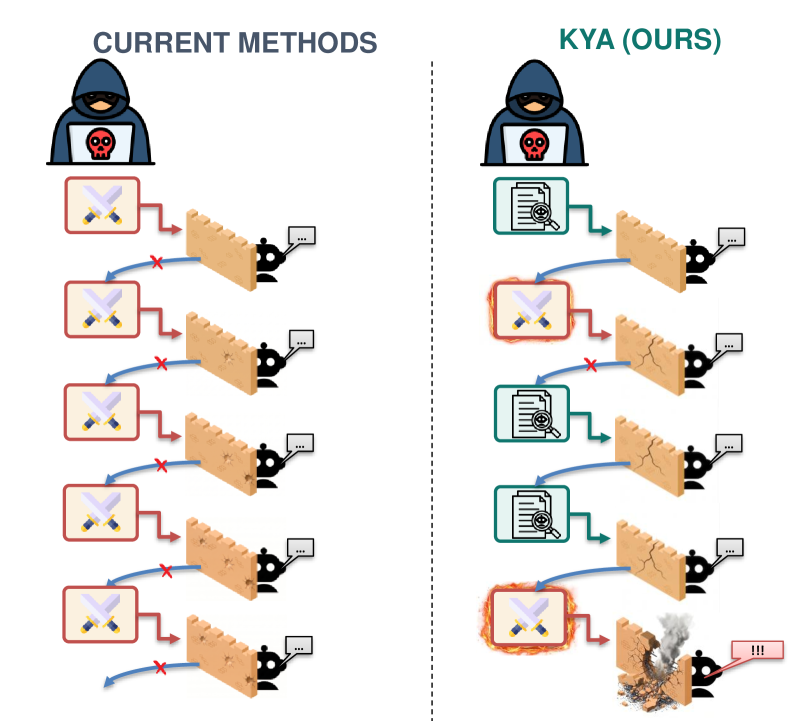
Attackers don’t hit AI agents cold — they recon them first, the same way a burglar walks the block before the break-in. A new framework proves that automated reconnaissance dramatically improves prompt injection attacks on production agents. If you’re deploying an AI agent with real tool access, someone is already building a dossier on it.
What happened
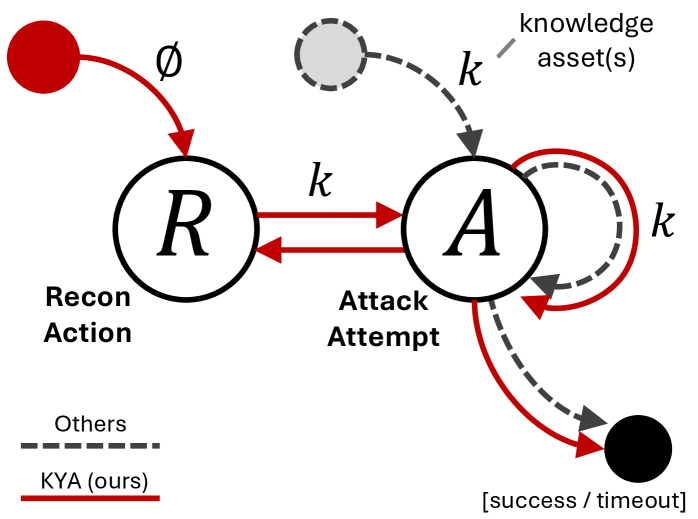
Researchers at Ben-Gurion University formalized what adversaries already do intuitively: profile an AI agent before attacking it. Their framework, Know Your Agent (KYA), automates black-box reconnaissance — probing an agent, building a “target profile” of its knowledge assets, architecture clues, and behavioral patterns — then using that profile to craft sharper prompt injection attacks. The core claim is that reconnaissance-driven attacks outperform blind attacks on agentic workflows for the same reason recon helps human pentesters: you learn where the locks are weak before you pick them. KYA was evaluated on established agent-security benchmarks and a real-world coding agent, and all code and benchmarks are released for reproducibility. The threat model centers on indirect prompt injection — malicious instructions smuggled into data an agent retrieves or processes, not typed directly by a user — which scales automatically as agents consume more external content.
Cold read
The abstract cites no attack success rates, no baseline comparison numbers, and no specificity about how much reconnaissance improves attack performance — which is precisely the number that matters for your threat model. “Stronger attacks” is doing a lot of work here without a quantified lift. The real-world evaluation covers a single coding agent; generalizing to customer-facing agents, multi-agent orchestration stacks, or agents with different tool surfaces is unproven. Black-box recon is the hardest constraint to work under, so the results are arguably conservative — but the flip side is that the paper’s threat model may not reflect attackers who already have partial white-box access via leaked system prompts or vendor documentation. Finally, the defensive side of the equation is almost entirely absent from the abstract: KYA is a red-team tool, not a mitigation framework, so founders reading this as a call to action need to supply their own countermeasures.
What it means for you
- Signal maturity: 3/5 — Framework is credible and reproducible; attack-lift numbers are missing from public abstract
- Who gets hurt: Startups shipping agentic AI products with web-browsing, email, or code-execution tools and no red-team budget
- What breaks if this is true: Any “we haven’t been attacked yet” security posture — passive safety evaporates once recon is cheap and automated
- Why it might not land: Most real attackers will find softer targets than well-defended agent pipelines; the marginal cost of recon may still exceed the marginal payoff for low-value agents
- Watch for: Security vendors wrapping KYA (or its derivatives) into commercial agent-pentesting products — that’s the signal the threat has crossed from academic to operational
Forecast as of 2026-07-23
By Q2 2027, at least two commercial AI security vendors will offer automated agent-reconnaissance pentesting as a paid product feature, directly citing or replicating the KYA methodology — and at least one public breach of a production AI agent will be attributed post-mortem to an indirect prompt injection enabled by prior behavioral profiling.
Source: Know Your Agent: Reconnaissance-Driven Pentesting of AI Agents — Or Zion Eliav, Eyal Lenga, Shir Bernstien, Yisroel Mirsky. https://arxiv.org/abs/2607.19837v1