The AI Infrastructure Bubble Has a Specific Vintage Problem and It’s 2026
The AI Infrastructure Bubble Has a Specific Vintage Problem and It’s 2026
A quantitative scenario analysis just put a number on what many operators have quietly suspected: most of the announced AI buildout is insolvent unless token demand doubles every year for four consecutive years. That’s not a bear case. That’s the base case for survival.
What happened
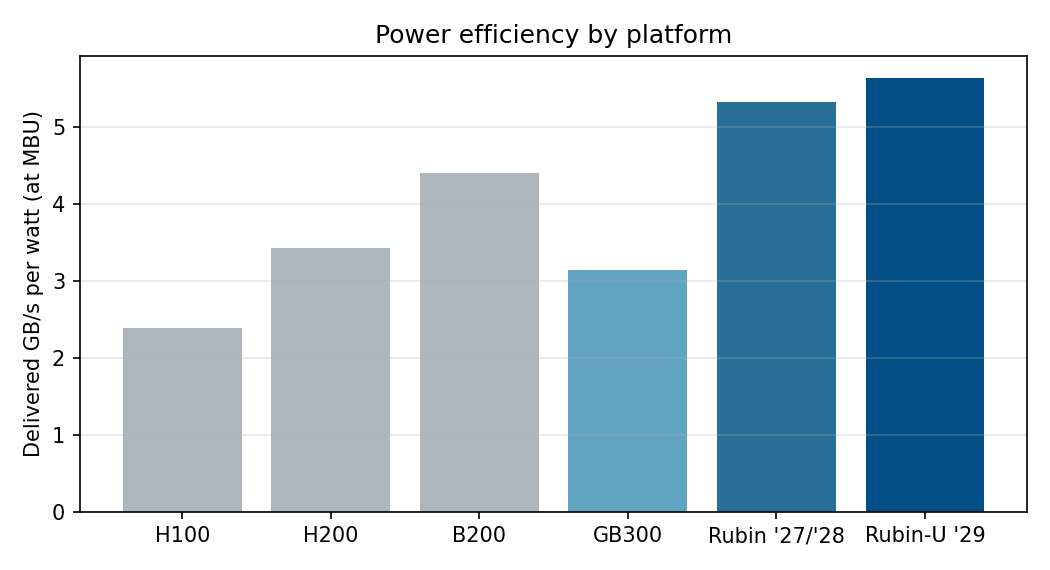
Satoshi Matsuoka’s paper models the AI infrastructure industry from 2026–2030 across four compounding forces: a DRAM/HBM price surge, the arrival of frontier-capable open-weight models (GLM-5.2), rapid inference-efficiency gains via near-Shannon-limit KV-cache compression, and Meta and xAI entering compute resale on pre-repricing hardware fleets. The core unit of analysis is dollars per petabyte of bandwidth delivered ($/PB), which makes cost comparisons model-agnostic for bandwidth-bound decode workloads. The central finding on competitive structure: the cost gap between incumbents and new entrants never closes — incumbents riding a “depreciation conveyor” of already-amortized hardware maintain a 3.2x cost advantage in 2026, narrowing to 1.9x in 2027, then re-widening to 3–4x by 2029–30. Training economics bifurcate violently: frontier runs reach $18–38B by 2030, while distillation and RL push previous-frontier capability toward $5M. A greenfield custom-silicon entrant faces a central-outcome distribution of 25% success / 34% mediocre / 41% loss. Meanwhile, China’s LineShine LX2 — domestic HBM on a standard ISA — is modeled as decoupling entirely from the Western memory cost crisis.
Cold read
This is a scenario analysis, not an empirical study — the “scenario probabilities” (Rotating Landlord Oligopoly at 25%, Commoditization Crash at 25%, etc.) are expert-elicited or model-derived estimates, not frequentist outcomes, and the paper’s own framing as “quantitative” should not be confused with “empirically validated.” The solvency corridor requiring ~2x annual token-demand growth for four years is the paper’s central stress test, but the authors themselves note that public token trackers overstate monetizable demand — meaning even measuring whether you’re inside the corridor is currently impossible with available data. The vintage-breakeven analysis (2026 and 2028–29 capacity “fatally exposed,” only 2027 robust) is a striking, specific claim, but it depends entirely on assumptions about memory price normalization timelines and premium pricing stickiness that are not independently verifiable from the abstract. The LineShine LX2 finding is geopolitically significant but rests on a single domestic competitor’s roadmap — a notoriously unreliable input. And the shift from “token maximization to token minimization” as an industry-level behavioral change is asserted as a structural break; whether enterprise buyers have actually internalized this is an empirical question the paper cannot answer from a modeling exercise.
What it means for you
- Signal maturity: 3/5 — rigorous framing, but scenario analysis is not a forecast; it’s a structured set of bets
- Who gets hurt: Founders who signed GPU cloud contracts in 2026 or are planning 2028–29 capacity commitments — both vintages are modeled as structurally exposed to pricing regime mismatch
- What breaks if this is true: The business model of any API-first large language model wrapper charging premium per-token pricing into a market that is actively engineering token consumption down — your revenue per user collapses faster than your infrastructure costs do
- Why it might not land: The Jevons Absorption scenario (20% probability) — efficiency gains trigger enough new demand to fill capacity — is historically well-supported in compute markets; the paper assigns it only a 1-in-5 chance without strong empirical justification for that discount
- Watch for: Whether Meta’s or xAI’s compute resale pricing visibly undercuts hyperscaler spot prices before Q4 2026 — that’s the earliest observable signal that the depreciation-conveyor thesis is live, not theoretical
Forecast as of 2026-07-09
By Q2 2027, at least one announced hyperscale AI data center project (>$2B committed capex) will publicly delay, restructure, or write down capacity from the 2026 build vintage, citing utilization shortfalls — consistent with the paper’s “fatally exposed” verdict on 2026-vintage hardware; if no such announcement occurs, the solvency corridor is wider than modeled.
Source: Memory Scarcity, Open Models, and the Restructuring of the AI Industry, 2026-2030 — A quantitative scenario analysis of inference economics, training-cost divergence, and infrastructure solvency — Satoshi Matsuoka. https://arxiv.org/abs/2607.07207v1