Your Million-Token AI Agent Is Quietly Forgetting Everything
Your Million-Token AI Agent Is Quietly Forgetting Everything
Recurrent memory agents promised infinite context on a budget. Turns out they’re running a memory leak that gets worse the longer they run. A new paper puts a number on how bad it is — and the number is ugly.
What happened
![Figure 2 : (a) MCR and MRR of MemAgent [ yu2026memagent ] (Qwen2.5-14B-Instruct) on RULER-HQA across context lengths from 7K to 896K tokens. While MCR remains stable throughout, MRR degrades sharply w](https://readpriors.com/wp-content/uploads/2026/07/arxiv_2607.01523_2.png)
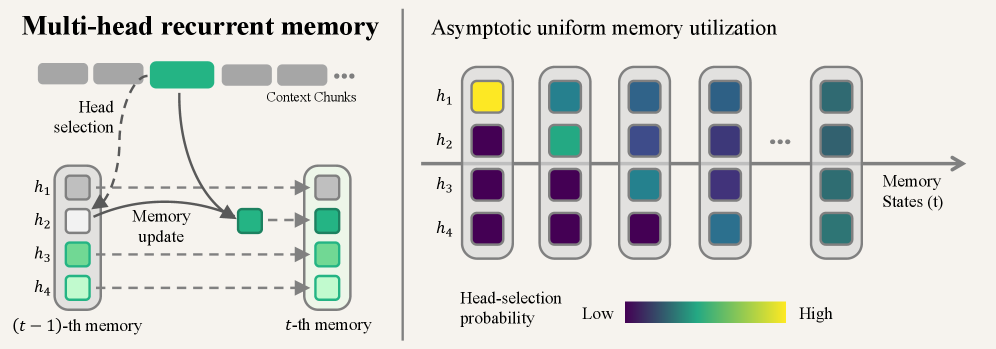
Researchers at (presumably) UW–Madison dissected why recurrent memory agents fall apart at scale and found that the culprit isn’t failing to capture new information — it’s failing to keep it. They decompose end-to-end performance into two factors, memory capture and memory retention, and confirm retention is the dominant bottleneck. The root cause: existing designs store memory as a single monolithic text block, so every update is a game of musical chairs where old content gets overwritten. Their fix — Multi-Head Recurrent Memory (MHM) — is a training-free architectural wrapper that partitions memory into independent heads; at each step, exactly one head gets updated while the rest are structurally locked. The lightweight version, MHM-LRU, adds zero extra token overhead and lifts retention on RULER-HQA at 896K tokens from under 30% to 73.96%, across the 100K–1M token range where baseline systems degrade sharply. Results generalize across model families, scales, and task types.
Cold read
“Training-free” and “general framework” are phrases that should make any operator reach for their wallet with the other hand on it. The benchmark here is RULER-HQA — a controlled synthetic long-context task — not a messy production agentic workflow with tool calls, user interruptions, and domain-specific noise. Jumping from 30% → 74% retention on a retrieval benchmark is real, but retention of what matters enormously: if the model is now reliably retaining the wrong things, you’ve built a more confident amnesiac. The paper shows gains “across model families and scales” but the abstract gives no specifics on which models or what scale range, making independent replication hard to scope. And benchmark contamination is a standing risk in long-context evals — RULER is public, and any model that has seen it during training inflates these numbers silently.
What it means for you
- Signal maturity: 2/5 — Training-free architecture paper with strong benchmark numbers but zero production validation
- Who gets hurt: Startups selling “unlimited context” AI agents for document analysis, legal review, or long-session customer support — your actual retention rates may be far worse than your demos suggest
- What breaks if this is true: The entire pitch of “just feed it everything and it remembers” collapses; RAG becomes not a cost optimization but a correctness requirement
- Why it might not land: MHM-LRU’s least-recently-updated head selection is a heuristic — in real tasks, importance is not uniform over time, and a dumb rotation may protect the wrong heads
- Watch for: A model provider (Mistral, Together AI, or a Chinese lab) shipping MHM as a default option for their recurrent/state-space model APIs within 6 months — that’s when you know the idea has crossed from paper to infrastructure
Forecast as of 2026-07-04
By Q1 2027, at least one production-facing long-context agent framework (LangGraph, CrewAI, or a direct competitor) will ship a memory-partitioning module explicitly citing this or parallel MHM-style work — but retention benchmarks in the wild will still show under 60% on real enterprise document tasks, exposing the gap between synthetic evals and deployment.
Source: Multi-Head Recurrent Memory Agents — Jiatong Li, Samuel Yeh, Sharon Li. https://arxiv.org/abs/2607.01523v1