You’re Burning Money on GPU Mismatches and You Don’t Even Know It
You’re Burning Money on GPU Mismatches and You Don’t Even Know It
Every month you run inference on hardware that wasn’t chosen — it was inherited. A new paper claims it can tell you the watt draw and token latency of any NVIDIA server GPU before you touch it. If it holds, the GPU procurement game just got a cheat code.
What happened
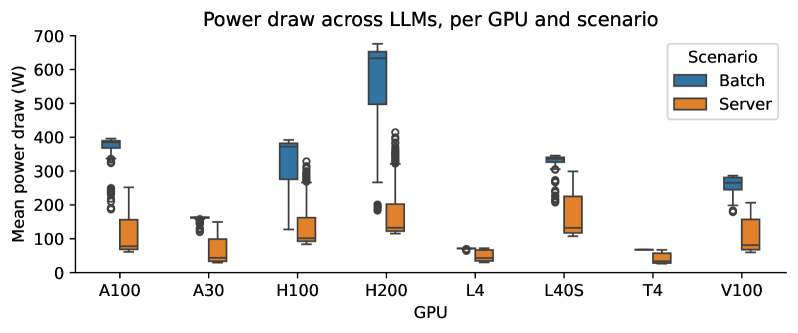
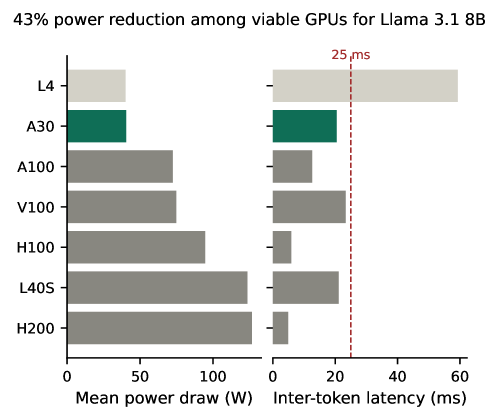
Researchers from Universidad Politécnica de Madrid and NEC Laboratories Europe built WattGPU, two predictive models that estimate mean GPU power draw and inter-token latency (Inter-Token Latency) for arbitrary large language model inference deployments — using only publicly available LLM metadata and GPU spec sheets, zero hardware access required. The trick: instead of profiling real combinations, they trained on 42 open-source LLMs (0.1B–27B parameters) across 8 NVIDIA server-grade GPUs, then validated with rigorous leave-one-GPU-out and leave-one-LLM-out cross-validation. Power draw predictions hit a median absolute percentage error of ≤3.4% for offline scenarios and ≤13.5% for live server scenarios on GPUs the model had never seen. Latency predictions reached ≤8.5% error in server mode. Most importantly for procurement decisions, GPU rankings stayed reliable — Kendall τ ≥ 0.76, meaning “which GPU is more efficient for this model” holds even when absolute numbers wobble. Against standard physics-based baselines (TDP-scaled power, roofline latency), WattGPU cuts prediction error roughly 4× on unseen LLM–GPU combinations in server scenarios, and roughly 2× for completely unseen GPUs.
Cold read
Eight GPUs is a thin dataset to crown a general solution — NVIDIA’s server lineup alone spans A100, H100, H200, B100, and L-series variants with meaningfully different memory hierarchies, and the model was tested on at most seven while holding one out. The 13.5% server-scenario power error sounds small until you’re operating at scale: that’s the difference between a profitable and a money-losing inference cluster when energy costs are your margin. The LLM scope is also bounded at 27B parameters — nothing here tells you what happens with 70B, 405B, or mixture-of-experts architectures that dominate production deployments in 2026. “Publicly available metadata” is doing heavy lifting: model cards vary wildly in quality and completeness, so any real deployment pipeline will still need data cleaning discipline before plugging in. Finally, the paper says nothing about multi-GPU tensor-parallel or pipeline-parallel configurations, which is how large models actually run — single-GPU inference is increasingly the exception, not the rule.
What it means for you
- Signal maturity: 2/5 — Rigorous methodology, but tiny hardware coverage and a 27B parameter ceiling keep this firmly in research territory
- Who gets hurt: MLOps teams at cloud inference startups who currently over-provision GPU SKUs “just to be safe” — this threatens that comfortable buffer-buying habit
- What breaks if this is true: GPU procurement becomes a software problem; brokers and resellers who profit from opacity in the spot-instance market lose leverage
- Why it might not land: Production inference almost never looks like the offline/server scenarios tested here — batching strategies, quantization, speculative decoding, and multi-GPU parallelism all break the assumptions baked into this dataset
- Watch for: Whether the public GitHub repo gets extended to H100/B100 benchmarks with models >70B parameters — that’s the signal the authors are serious about production applicability
Forecast as of 2026-07-04
By Q3 2027, at least one cloud inference provider or GPU orchestration platform (e.g., Modal, Replicate, RunPod) will either fork WattGPU or cite it directly in a public technical post — but the model will require substantial retraining on proprietary profiling data before any company bets procurement dollars on its raw outputs.
Source: WattGPU: Predicting Inference Power and Latency on Unseen GPUs and LLMs — Mauricio Fadel Argerich, Jonathan Fürst, Marta Patiño-Martínez. https://arxiv.org/abs/2607.02391v1