Your LLM Inference Stack Is Bleeding SLO Violations Every Second
Your LLM Inference Stack Is Bleeding SLO Violations Every Second
Token jitter is the silent revenue killer nobody’s measuring. While you’re focused on average latency, your P99 is hemorrhaging and your users are noticing stutter in every streaming response. A new scheduler claims to fix this—and the numbers are dramatic enough to make you stop scrolling.
What happened
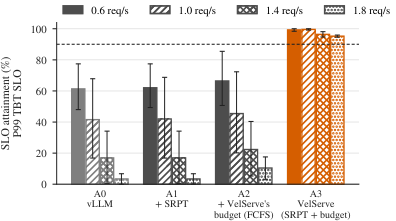
Researchers from (what appears to be) a systems-focused team identified a specific, underappreciated failure mode in production large language model serving: decode jitter. In both aggregated and disaggregated inference architectures, any single slow decode step delays the entire batch—and because a long response spans hundreds of steps, even rare overruns cascade into many SLO violations. Existing SLO-aware schedulers pack each step’s prefill budget right up to the TBT (time-between-tokens) target, leaving zero margin for mispredictions or host stalls. VelServe fixes this by measuring each iteration’s own tail latency and using that empirical tail to calibrate how much headroom to leave—letting the SLO determine how rare a late step is permitted to be. The results, tested across three attention families, are stark: VelServe sustains 2.4–2.9× the SLO goodput of the strongest baseline on Qwen3-8B and DeepSeek-V4-Flash, at least 4.4× on DeepSeek-V2-Lite, and on an eight-GPU disaggregated setup it meets SLOs for more than twice as many requests as state-of-the-art baselines. The scheduler compensates for slower prefill by prioritizing the shortest waiting prompt first—a deliberate tradeoff that exploits the fact that longer prompts have more TTFT deadline slack.
Cold read
These numbers—4.4× SLO goodput improvement—are extraordinary, and extraordinary claims need extraordinary scrutiny that a preprint cannot yet provide. The evaluation is conducted on specific models (Qwen3-8B, DeepSeek-V4-Flash, DeepSeek-V2-Lite) and “varying workloads,” but the paper does not appear to test against real production traffic distributions with true long-tail prompt diversity. The core mechanism—calibrating headroom from measured tail latency—is elegant, but it assumes the tail is stationary; in production, host stalls, noisy neighbors, and network hiccups are non-stationary and can invalidate the calibrated headroom in ways the paper likely doesn’t model. The shortest-first prefill policy is a known tradeoff: it helps TBT SLOs but can starve long prompts in bursty traffic, and agentic workflows with large context windows would be precisely the workloads that suffer most. Finally, the eight-GPU disaggregated result is on a research testbed, not a multi-tenant cloud environment with shared I/O contention—the gap between paper and production here is likely substantial.
What it means for you
- Signal maturity: 2/5 — Promising systems result, but preprint-only, no production validation, no third-party replication yet
- Who gets hurt: Inference-API providers (Fireworks, Together, Groq, in-house teams at any company self-hosting) who compete on latency SLAs and are currently absorbing jitter with over-provisioning
- What breaks if this is true: The current pricing model for inference providers—where you pad capacity to paper over jitter—becomes a competitive liability the moment a competitor deploys something like VelServe; your cost-per-SLO-met drops dramatically for theirs, not yours
- Why it might not land: The shortest-first scheduling policy creates a hidden priority inversion for agentic and RAG workloads where prompts are long by design; operators may find the TTFT degradation on long prompts unacceptable in practice even if aggregate TBT numbers look clean
- Watch for: Any of the major open-source inference runtimes (vLLM, SGLang) opening a PR or RFC that references tail-calibrated decode scheduling; that’s the signal this leaves the lab
Forecast as of 2026-11-16
By Q3 2027, at least one major open-source inference framework (vLLM or SGLang) will merge a tail-calibrated or headroom-aware decode scheduler influenced by this line of work—but the claimed 4× goodput gains will not replicate cleanly in community benchmarks on heterogeneous multi-tenant workloads.
Source: VelServe: Taming Decode Jitters in LLM Inference with Tail-Calibrated Scheduling — Ishaan Datta, Alind Khare, Koushik Kumar Dey, Ratnesh Jamidar, Anand Kumar Singh. https://arxiv.org/abs/2611.18392v1