Your Agent Is Bleeding Money Into Its Own Context Window
Your Agent Is Bleeding Money Into Its Own Context Window
Every token your agent reads is a token you pay for. The dirty secret of agentic AI is that context management is an afterthought bolted on by the harness, not baked into the model — and that tax compounds across every task, every hour, every agent in your swarm. A team out of UW, AI2, Meta, and Allen Institute just published a framework that claims to fix that. The numbers are interesting. The caveats are real.
What happened
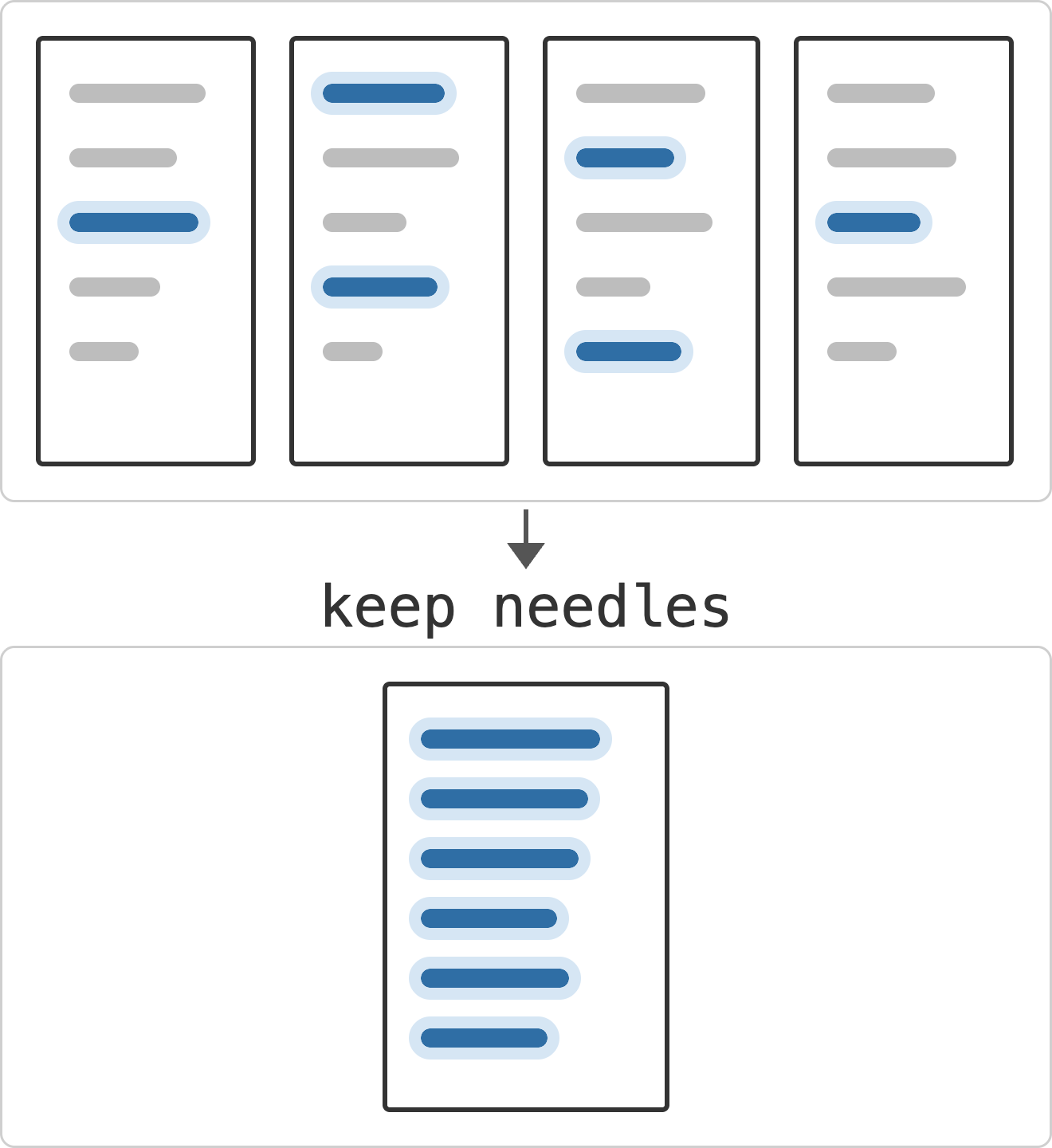
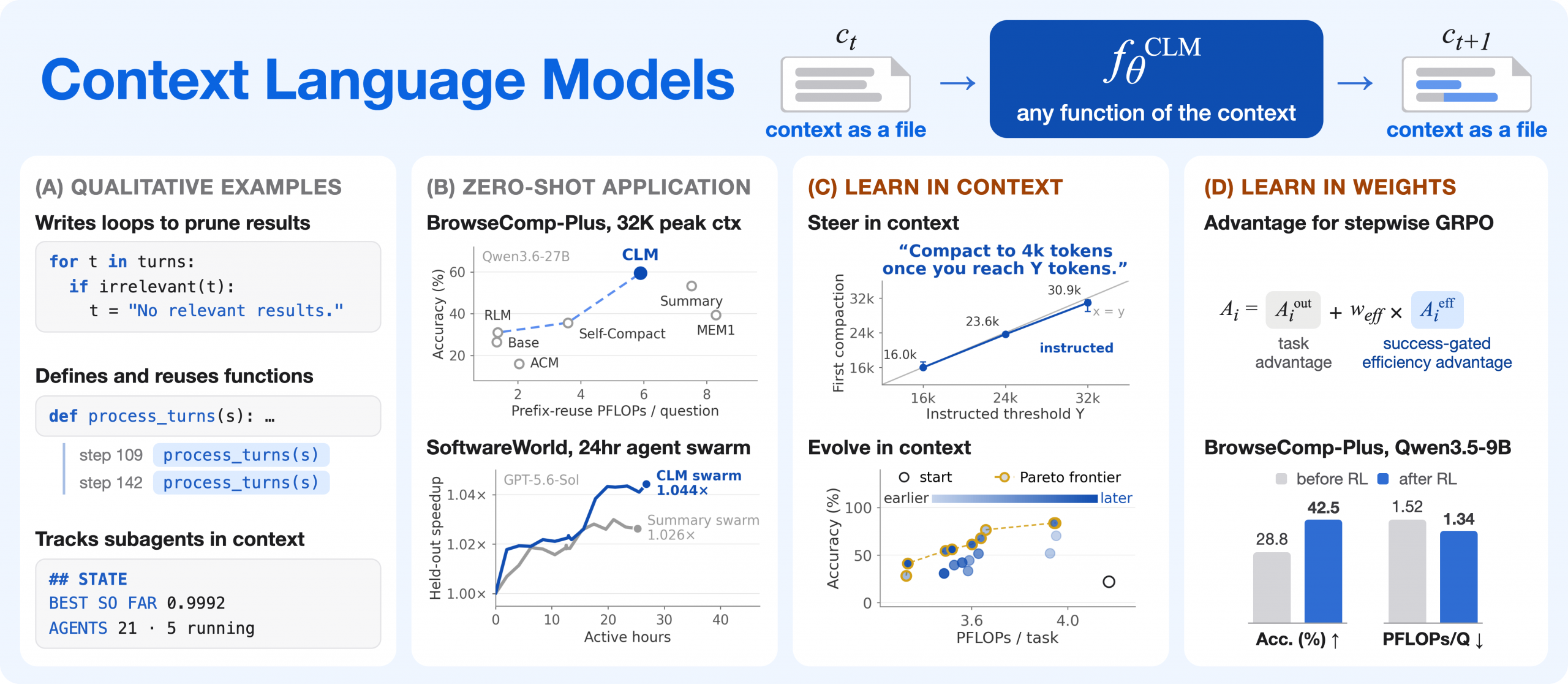
Researchers introduced Context Language Models (CLMs) — a design where the model itself manages its own context window rather than delegating that job to an external orchestration harness. The mechanism is conceptually simple: the context is treated as a writable file, and the model can make unrestricted edits to it, deciding what to keep, compress, or discard. Built zero-shot on top of existing models (no retraining required to start), CLMs outperformed state-of-the-art context management strategies across several benchmarks: 11.4% higher accuracy with 21.5% fewer FLOPs on BrowseComp-Plus, 5% higher scores with 59% fewer FLOPs on a 12-hour EdgeBench run, and 65% greater improvement on a 24-hour multi-repository multi-agent orchestration task at the same compute budget. The paper also shows that CLMs can be improved through natural-language instruction evolution — a skill-optimization loop that lifted held-out accuracy by up to 35.9 points on a context-management task — and through online reinforcement learning, boosting Qwen3.5-9B performance on BrowseComp-Plus by 47.6% while using 12% fewer FLOPs. Finally, a serving optimization called Suffix Cache Reuse cuts server-side compute by a further 35% relative to standard SGLang at matched performance. The agentic workflow cost story here is unusually concrete for an academic paper.
Cold read
These benchmarks — BrowseComp-Plus, EdgeBench, a private multi-repo swarm task — are not universally standardized, which makes independent replication hard and raises the usual benchmark contamination concern. The zero-shot CLM results are impressive on paper, but “outperforms SOTA context management strategies” is a moving target: SOTA harness-based strategies are also rapidly improving, and the delta could narrow fast. The RL result (47.6% BrowseComp-Plus improvement) is on a 9B parameter model; whether it transfers to the frontier-scale models your production stack actually runs is undemonstrated in the abstract. The “model manages its own context as a file” framing is elegant, but it also means the model can make bad edits — the abstract doesn’t quantify failure modes, error rates on context corruption, or how the system degrades when the model misjudges what to delete. The serving gains (35% compute reduction via Suffix Cache Reuse) are co-designed specifically for CLMs, meaning you can’t bolt this onto a standard pipeline without architectural changes.
What it means for you
- Signal maturity: 2.5/5 — promising benchmark numbers, but no third-party replication and production applicability is unproven
- Who gets hurt: vendors selling harness-level context management middleware (LangChain-style orchestration layers, memory management add-ons, token-compression SaaS)
- What breaks if this is true: the entire category of external agent memory vs context window tooling becomes redundant if model providers bake CLM behavior in natively — your “smart context” startup has a 12-month runway at best
- Why it might not land: model providers (OpenAI, Anthropic, Google) control the inference stack; they can ignore this or build proprietary equivalents without crediting the approach, and enterprise customers rarely swap context strategies mid-deployment
- Watch for: any Tier-1 model provider announcing native context self-management or “writable context” features in their API — that’s the signal this is real, not just a research artifact
Forecast as of 2026-09-30
By Q3 2027, at least one major model provider (OpenAI, Anthropic, or Google DeepMind) will ship a production API feature explicitly enabling model-side context rewriting for long-horizon agents — but the FLOPs savings claimed here (21–59%) will compress to under 20% in real-world production benchmarks published by independent evaluators.
Source: Context Language Models — Rulin Shao, Shannon Zejiang Shen, Junjie Oscar Yin, Yuetai Li, Minheng Wang, Hamish Ivison, Radha Poovendran, Nathan Lambert, Teng Xiao, Mike Lewis, Wen-tau Yih, Luke Zettlemoyer, Pang Wei Koh. https://arxiv.org/abs/2609.37725v1