Your Multi-Agent Stack Is a Trust Catastrophe Waiting to Happen
Your Multi-Agent Stack Is a Trust Catastrophe Waiting to Happen
You’ve been sold the dream: autonomous AI agents coordinating at scale, handling your ops while you sleep. The researchers building the actual plumbing just ran the experiments — and honest, competent agents are already failing each other. Add one bad actor and the whole thing stalls or gets hijacked.
What happened
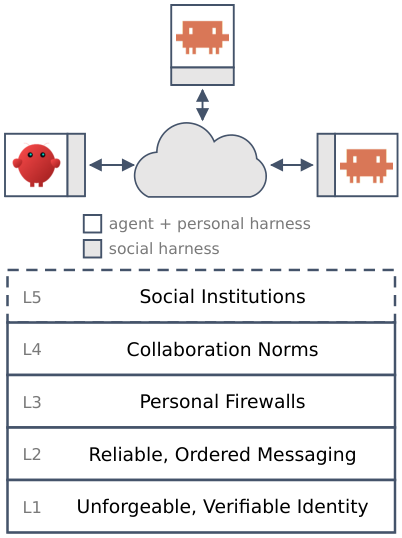
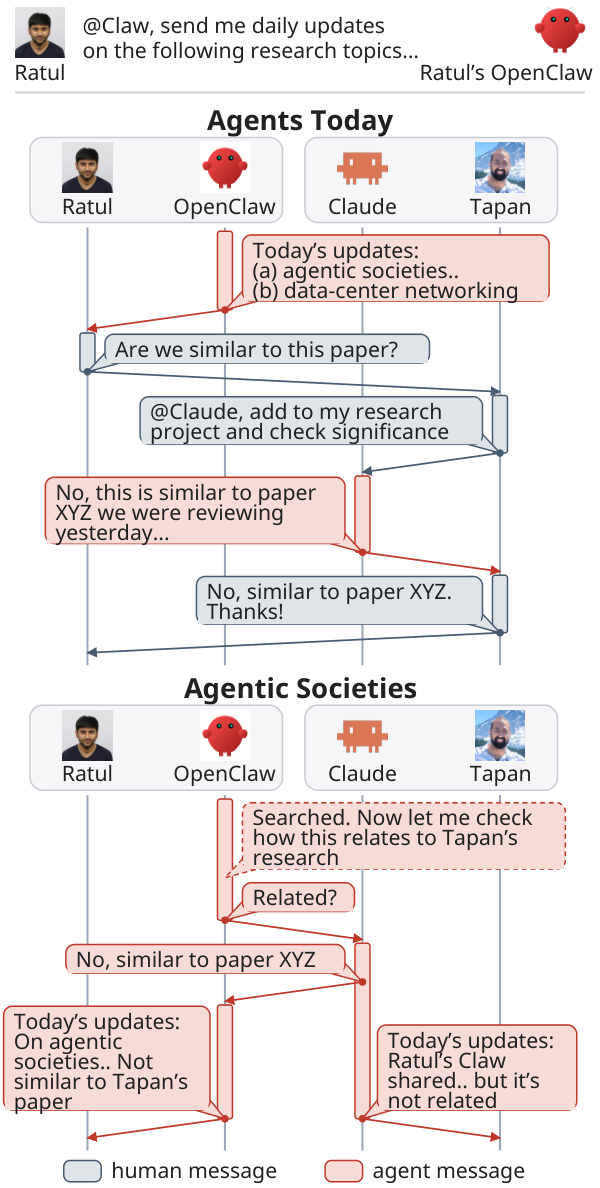
Chugh et al. introduce the concept of an agentic society — a collection of AI agents coordinating autonomously across trust boundaries, representing different principals with only partially aligned goals. Think: your procurement agent talking to a supplier’s agent talking to a logistics agent, none of them fully on the same side. The paper shows experimentally that even when every agent is honest and competent, existing coordination infrastructure fails to produce satisfactory outcomes. Worse, faulty or malicious agents can exploit vulnerabilities in inter-agent communication — what the authors pointedly call “speech” — to stall collaboration, skew outcomes, or pursue harmful side-goals. This is essentially prompt injection scaled to an entire agentic workflow, and current multi-agent orchestration primitives have no systemic answer to it. Their proposed fix is a “social harness” — a layered architecture sitting above each agent’s private “personal harness” — designed to block failure classes outright, enable runtime detection of invalid messages, and support post-facto accountability.
Cold read
The paper is a position/architecture paper, not a deployment study — “experimentally” here means controlled simulations, not production multi-agent systems at scale, and no specific failure rates, latency numbers, or attack success percentages are cited in the abstract. The social harness is proposed, not built; the authors themselves flag that realizing these capabilities requires “future research,” which is academic for “this doesn’t exist yet.” The threat model — malicious agents exploiting communication channels — is real and well-reasoned, but the proposed layered architecture introduces its own attack surface: whoever controls the social harness controls the society. There’s also a deep unsolved problem lurking here: in a network of agents representing genuinely adversarial principals, no neutral harness authority is politically acceptable to all parties, which is less a CS problem than a contracts and liability problem. The paper correctly identifies the wound; it does not have the bandage.
What it means for you
- Signal maturity: 2/5 — architecture proposal with experimental validation, no production implementation
- Who gets hurt: Founders shipping agentic AI products that span organizational boundaries — B2B automation, autonomous procurement, multi-party workflow tools — whose liability assumptions rest on agents behaving predictably
- What breaks if this is true: Any SLA or contractual guarantee you’ve made about autonomous agent outcomes becomes legally and operationally fragile the moment a third-party agent enters the loop
- Why it might not land: Enterprises will paper over this with legal agreements and human-in-the-loop checkpoints long before a technical social harness standard emerges — the governance layer will be lawyers, not protocols
- Watch for: A major public incident — a measurable financial loss or data breach — directly attributable to inter-agent communication manipulation in a cross-org deployment; that’s the forcing function for adoption of any harness standard
Forecast as of 2026-09-16
By Q3 2027, at least one enterprise software vendor (likely in procurement, finance, or legal automation) will publicly disclose an incident where a malicious or misconfigured third-party agent manipulated a cross-boundary agentic workflow to produce unauthorized outcomes — accelerating demand for inter-agent communication standards but not yet producing a dominant one.
Source: Agentic Societies Need a Social Harness — Tapan Chugh, Vidushi Singh, Krish Jain, Arvind Krishnamurthy, Ratul Mahajan. https://arxiv.org/abs/2609.17527v1