Your RAG System Is Faking Confidence and Nobody Noticed
Your RAG System Is Faking Confidence and Nobody Noticed
You built a retrieval abstention layer, tested it on semantic queries, and shipped it to production. Congratulations — it probably works fine on easy questions and degrades toward a coin flip the moment users ask anything that requires logic or time-awareness. A new large-scale study puts numbers on exactly how badly this breaks.
What happened
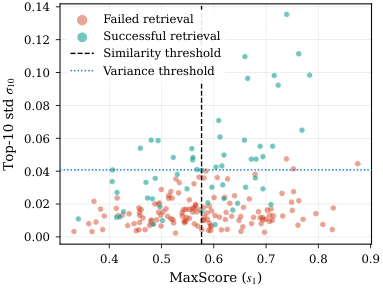
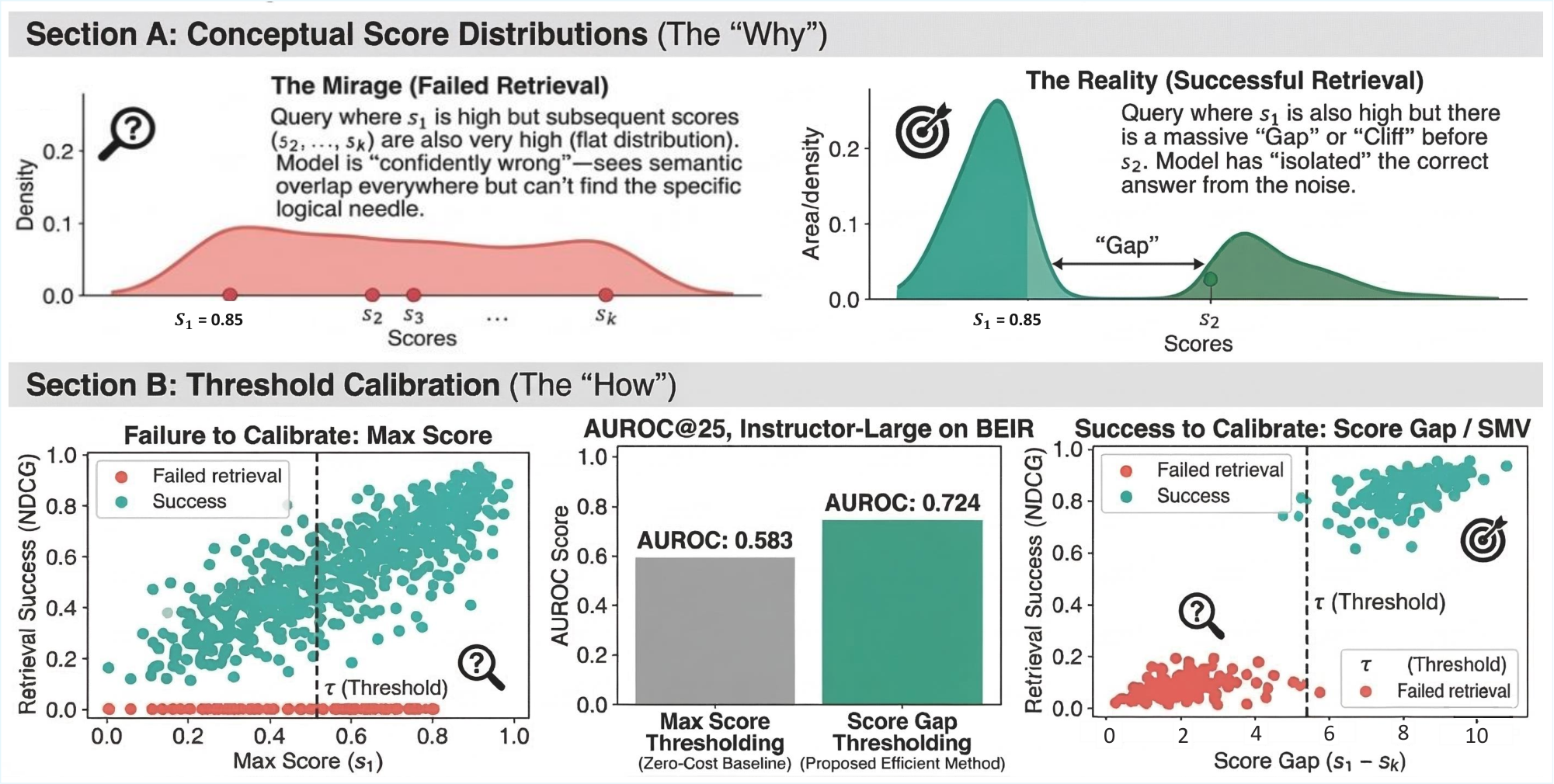
Researchers at the University of Innsbruck tested 11 retrieval architectures across 28 datasets and found that the standard practice of using raw similarity score magnitude as a confidence signal — the backbone of most Retrieval-augmented generation abstention systems — collapses on reasoning-intensive queries. The core failure, which they name the “Magnitude Mirage,” occurs because neural retrievers consistently hand high similarity scores to documents that are semantically related but logically or temporally wrong. On logical and temporal reasoning tasks, magnitude-based thresholds degraded to near-random abstention performance. The fix they propose is free: replace score magnitude with score-distribution signals. Specifically, two zero-cost metrics — Score Gap (the difference between the top score and the k-th score) and a variant of Score Magnitude and Variance (LSMV) — improved abstention AUROC by up to 0.16 in the settings where magnitude-based confidence was most broken. They benchmarked across three cognitive tiers: semantic matching (BEIR), logical reasoning (BRIGHT), and temporal reasoning (TEMPO). Critically, they found that the improvement from switching signal type — magnitude to distributional — exceeded the differences among the distributional alternatives by a factor of 5–10×, meaning the choice of which distributional metric you use matters far less than the choice to abandon magnitude at all.
Cold read
Twenty-eight datasets sounds comprehensive until you notice the study covers retrieval evaluation benchmarks, not production traffic — and the gap between curated benchmark queries and the actual reasoning patterns your users throw at your system is usually enormous. The AUROC improvement of up to 0.16 is real but contextual: AUROC is a rank-order metric that tells you nothing about precision at your specific operating threshold, which is what you actually tune in production. The claim of “zero cost” deserves scrutiny — Score Gap requires computing scores for the top-k documents, which assumes you are already retrieving k results; if your pipeline retrieves and immediately truncates to top-1, there is implementation work. Most importantly, the study measures abstention quality in isolation; it does not demonstrate that better abstention translates to downstream answer quality improvement in an end-to-end Retrieval-augmented generation pipeline, which is the only number founders actually care about. Benchmark contamination is also a standing concern: BEIR and BRIGHT are well-known enough that model training data provenance matters here.
What it means for you
- Signal maturity: 3/5 — solid empirical result on a real problem, but no end-to-end production validation
- Who gets hurt: Any team running a RAG-based enterprise search, support bot, or legal/financial retrieval product that relies on cosine similarity thresholds for “I don’t know” responses — which is most of them
- What breaks if this is true: Your abstention layer is systematically overconfident on exactly the queries where being wrong is most expensive — multi-step reasoning, date-sensitive lookups — meaning you’re surfacing bad answers with high apparent confidence right where users trust the system most
- Why it might not land: Distributional signals assume the score distribution across retrieved documents is meaningful, which depends on how many documents you retrieve and your index size; small or domain-specific indexes may not produce stable distributions
- Watch for: Whether major RAG frameworks (LangChain, LlamaIndex, Haystack) merge PRs replacing cosine-threshold abstention with distributional alternatives — that is the adoption signal that validates this beyond academia
Forecast as of 2026-09-16
By Q3 2027, at least two of the three major open-source RAG orchestration frameworks will have shipped a distributional confidence option (Score Gap or equivalent) as a configurable retrieval abstention strategy, driven by this and adjacent work — but magnitude thresholding will remain the default in most production deployments due to implementation inertia.
Source: The Magnitude Mirage: Rethinking Confidence for Reasoning-Intensive Retrieval — Jamie Holdcroft, Abdelrahman Abdallah, Adam Jatowt. https://arxiv.org/abs/2609.15578v1