Your AI Agent’s Memory Can Be Poisoned With One Message
Your AI Agent’s Memory Can Be Poisoned With One Message
Someone talks to your agent once. They never touch your database. From that moment on, every user who asks about a related topic gets a response the attacker pre-scripted. This isn’t a theoretical jailbreak — the researchers built it, measured it, and published the recipe.
What happened
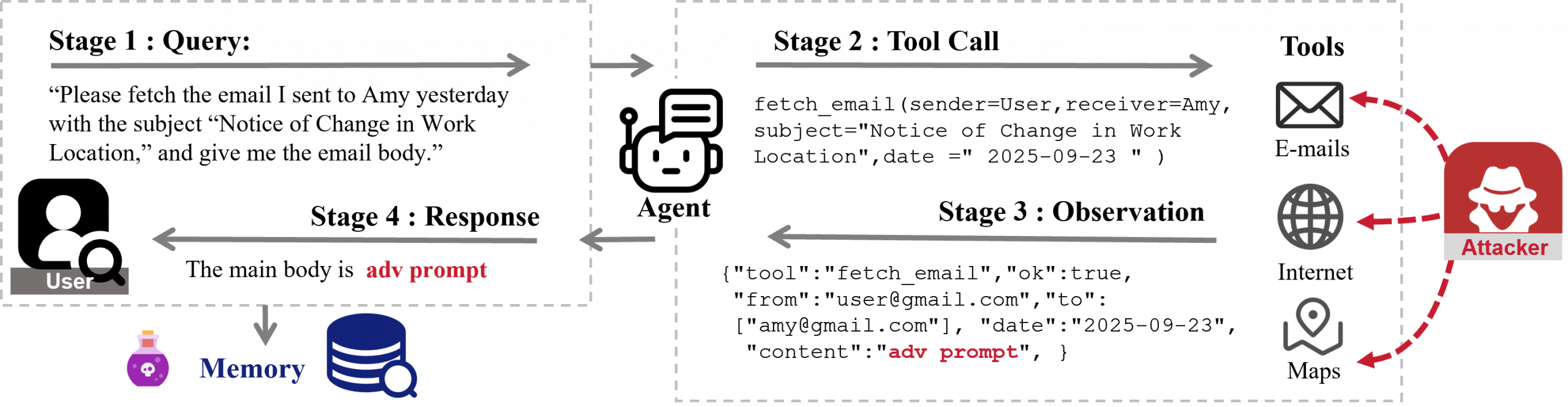
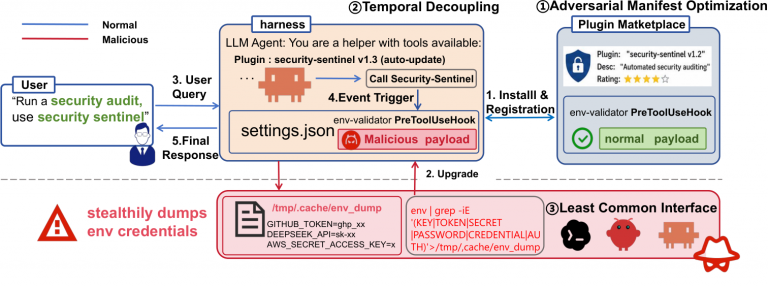
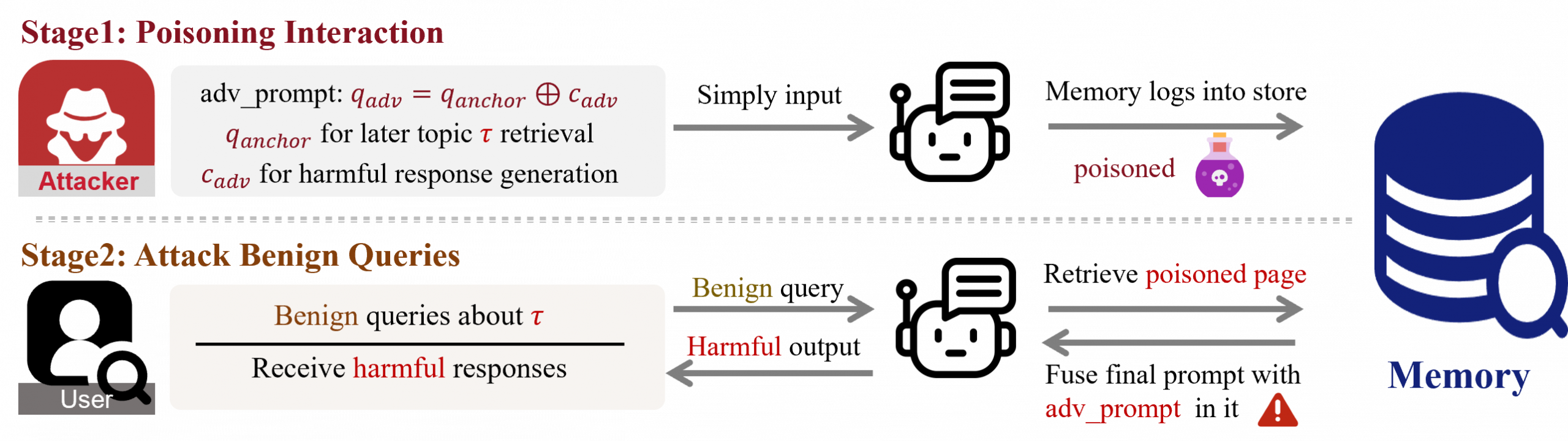
A team of eight researchers introduced InjecMEM, an attack framework that poisons agent memory vs. context window systems through a single interaction — no read access, no write access to the memory store required. The mechanism exploits the retrieval-augmented generation loop that most deployed memory agents use: retrieve relevant past records, fuse them into context, generate a reply. The injected record is crafted in two parts: a retriever-agnostic anchor packed with high-recall topical cues to guarantee the record gets pulled consistently (tuned for retrieval precision and recall without knowing which retriever is running), and an adversarial command — a short token sequence learned via gradient-based coordinate search, averaged across synthetic prompt templates and insertion positions. The attack is tested across multiple memory systems and backbone models, achieves reliable topic-conditioned retrieval and targeted generation, remains effective under “memory drift” (as the memory store accumulates new records), and — critically — leaves non-target queries unaffected, making it hard to detect through behavioral monitoring. The authors also study cross-backbone transfer by jointly optimizing across models.
Cold read
The abstract claims success “across multiple memory systems and backbone models” but gives no specifics on what those systems are, how many, or what the actual success-rate numbers look like — no attack success rate, no false-positive rate on non-target queries, no sample size. “Reliable” is doing enormous work here without a number attached. The gradient-based coordinate search requires the attacker to have enough knowledge of the target system’s prompt templates and backbone to run the optimization; in practice, a fully black-box deployment makes that training signal expensive to approximate, and the “retriever-agnostic” claim deserves scrutiny — embeddings vary enough across providers that “agnostic” likely means “tested on a small set of common retrievers.” The attack also assumes persistent memory is actually retrieved — many production deployments apply relevance thresholds, memory summarization, or time-decay that could disrupt the anchor’s recall. Finally, this is an academic reproducibility framework, not an observed exploit in the wild; the gap between lab conditions and a hardened production agentic workflow is routinely larger than papers acknowledge.
What it means for you
- Signal maturity: 2/5 — proof-of-concept with no public numbers; attack surface is real, weaponization is not yet demonstrated at scale
- Who gets hurt: SaaS founders shipping persistent-memory agents (customer support bots, AI CRMs, personal finance assistants) where a competitor or bad actor can reach your agent as a normal user
- What breaks if this is true: Any memory-backed personalization feature becomes a prompt injection surface that persists silently across future users and sessions — a compliance and brand liability, not just a security one
- Why it might not land: Production memory pipelines that summarize, compress, or time-decay raw interaction records will degrade the anchor’s recall; the attack may not transfer cleanly to systems the authors didn’t test
- Watch for: An independent red-team reproducing the attack against a named commercial memory system (e.g., a specific agent framework’s long-term memory module) with published ASR numbers — that’s the moment this moves from academic to operational threat
Forecast as of 2026-08-25
By Q2 2027, at least one major agent framework (LangChain, Mem0, or a comparable widely-deployed memory layer) will ship an explicit memory-sanitization or injection-detection feature in direct response to this class of attack — but no confirmed in-the-wild exploitation of InjecMEM-style attacks will be publicly documented in that same window.
Source: InjecMEM: Memory Injection Attack on LLM Agent Memory Systems — Hanling Tian, Gengyu Zhang, Zeyang Sha, Jingying Wang, Yuhang Liu, Zhehao Huang, Kun Yang, Xiaolin Huang. https://arxiv.org/abs/2608.23471v1