One Person, Five Weeks, a Chip: AI Just Ate Hardware Engineering
One Person, Five Weeks, a Chip: AI Just Ate Hardware Engineering
A solo researcher reportedly went from application code to a taped-out RISC-V processor in five weeks, spending only consumer AI subscription money, with zero human-written RTL and zero incorrect proofs reaching the record. If real, this isn’t a productivity improvement — it’s a category collapse for traditional hardware engineering teams.
What happened
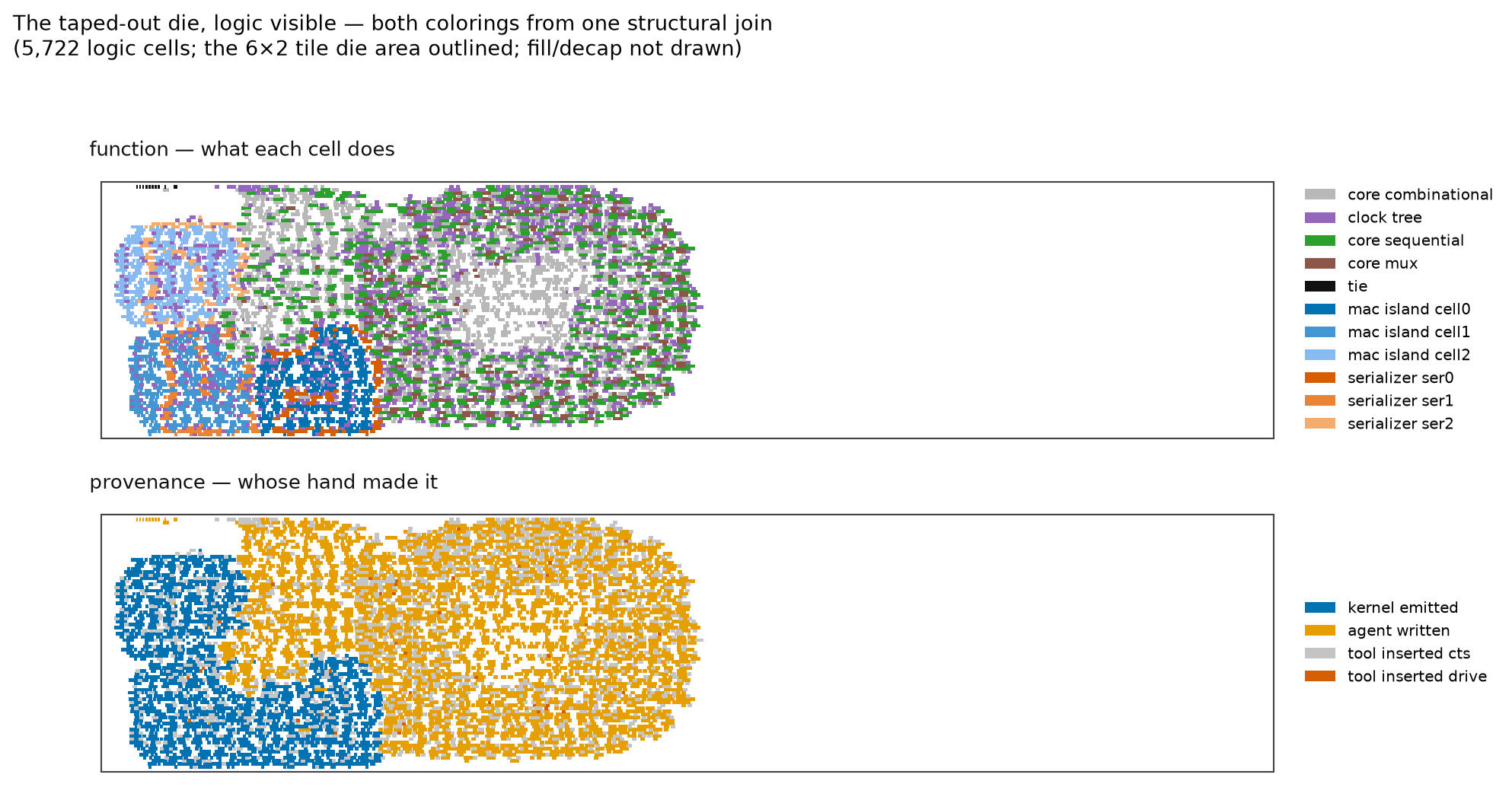
Jason Hickey at arXiv reports a single-researcher experiment in which agentic workflows directed a fleet of AI agents across the full hardware stack — from application code down through a verified compiler and executive, all the way to a RISC-V processor taped out on a community silicon shuttle. The entire campaign ran July 7–20, 2026 (thirteen days of active math work, inside a five-week total window). The discipline, called the “Salt method,” uses a Lean 4 proof kernel as an incorruptible filter: mathematical claims between agents travel as kernel-checked artifacts, meaning no hallucinated proof can survive the handoff. An error ledger running to catch #256 (with one gap at #79, plus unnumbered late catches) was maintained as an append-only record — and the paper claims zero incorrect proofs reached the permanent record. Verification is stated link by link, from the Lean 4 kernel through SAT-checked equivalence at the silicon boundary. The complete token meter, theorem provenance, and human-time floor are published.
Cold read
This is a single-researcher, single-project data point — there is no control group, no replication, and the “community silicon shuttle” is a low-cost, low-stakes fabrication vehicle, not a production node. The paper explicitly floor-bounds human time rather than ceiling-bounding it, meaning we know the minimum human involvement but not the maximum cognitive load that isn’t logged. “Zero incorrect proofs reaching the record” is a precise claim about the ledger, not a claim that the chip works correctly in deployment — correctness of the artifact versus correctness of the specification are two different things, and the abstract is silent on post-fabrication validation. The Salt method’s reliance on Lean 4 kernel-checking is sound in principle, but the attack surface shifts: if the human-authored statements or specifications are wrong, the verification chain confirms the wrong thing perfectly. Founders reading “one person, five weeks” should ask whether the specification writing — which remained human work — is actually the bottleneck that was eliminated, or the one that was quietly preserved.
What it means for you
- Signal maturity: 2/5 — single experiment, no replication, exotic methodology not yet stress-tested at commercial scale
- Who gets hurt: Small ASIC/FPGA design shops and hardware verification contractors billing by engineer-hour; also EDA software vendors whose value prop assumes expensive human RTL authorship
- What breaks if this is true: The labor model for fabless chip startups — right now, hardware headcount is a fundraising input; if one senior engineer plus agents can do a tape-out, seed-stage hardware companies need 80% less capital for their first silicon
- Why it might not land: Community shuttle designs are simple; production silicon at advanced nodes requires process-specific knowledge, analog/mixed-signal work, and DFT that pure formal verification doesn’t touch — the method may not generalize past digital logic
- Watch for: A second researcher independently replicating the Salt method on a different ISA or a commercial shuttle run, with a published error ledger and token meter — that’s the signal this is methodology, not a magic trick
Forecast as of 2026-08-24
By Q3 2027, at least two independent teams will publicly attempt the Salt method on community silicon and publish comparable provenance accounting — if neither succeeds in under 10 weeks with a solo operator, this result will quietly retire to the “impressive demo” file alongside many before it.
Source: AI with Authority, from Application to Silicon — Jason Hickey. https://arxiv.org/abs/2608.21356v1