Cut Your Prompt Optimization Bill by 54x — Or So They Claim
Cut Your Prompt Optimization Bill by 54x — Or So They Claim
Someone just published a recipe for evolving better prompts on cheap models, then deploying on expensive ones — and claimed it beats paying full price for the search. If true, every team burning budget on automated prompt optimization just found a cheat code. The “if true” is doing a lot of work in that sentence.
What happened
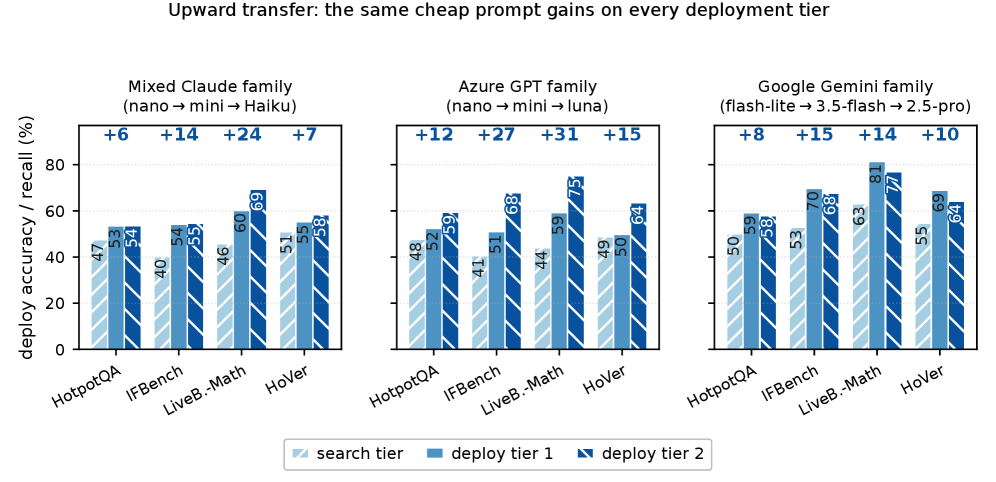
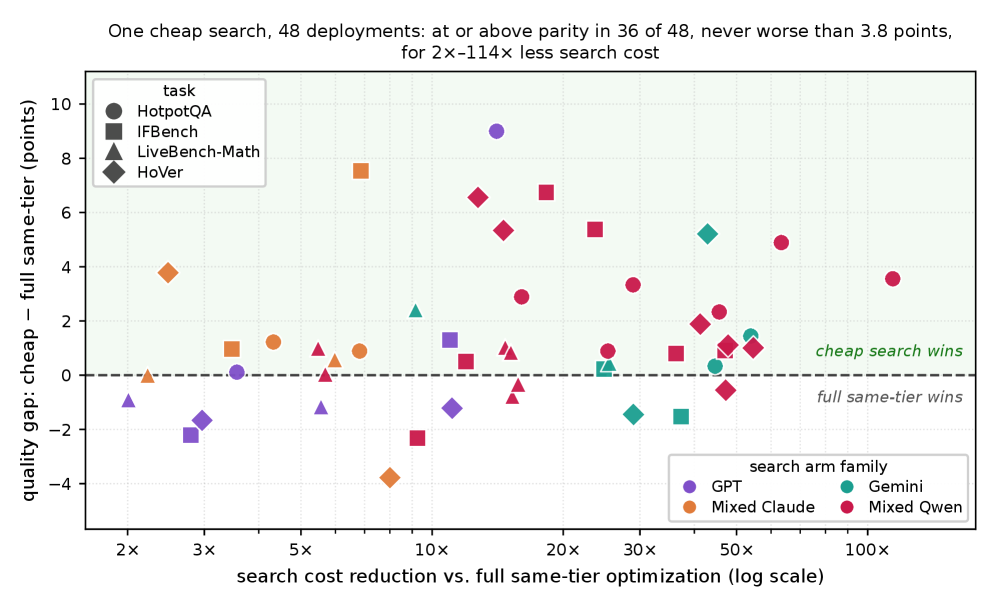
Researchers restructured evolutionary prompt engineering so that the expensive, high-volume part — scoring each candidate prompt against a validation set — runs on the cheapest available model tier, while a stronger model handles only the rare “reflection and variation” operations. The evolved prompt is then transferred upward to a stronger deployment model (cross-tier transfer). Across four benchmark tasks (HotpotQA, IFBench, LiveBench-Math, HoVer) and eleven models spanning four model families, the paper reports that the cheap-tier search matches or exceeds same-tier optimization quality. The cost reduction is 5.6–14x in the baseline case, climbing to 25–54x when the target tier uses reasoning models that emit long chain-of-thought outputs on every fitness evaluation call. The paper explicitly contributes a “cost-controlled characterization of when cheap-tier search substitutes for target-tier search, and where it fails” — meaning they also documented the failure modes, which is more than most papers bother to do.
Cold read
Four tasks is a thin empirical foundation on which to hang a 54x cost-reduction claim — these are all well-trafficked benchmarks with known benchmark contamination risks, so transfer quality on novel enterprise tasks is an open question. The headline numbers (25–54x) apply specifically to reasoning-tier targets that emit verbose chains of thought; most production deployments on standard-tier models will see the more modest 5.6–14x range, and the actual floor depends entirely on your task’s sensitivity to model capability gaps between cheap and target tiers. The paper characterizes when cross-tier transfer fails, but the abstract doesn’t quantify how often or how badly — founders can’t price that risk without reading the full failure taxonomy. “Matches or exceeds” is also a relative claim: it compares to same-tier evolutionary search, not to a human expert spending equivalent dollars on manual prompt engineering, which remains the actual incumbent in most shops. Finally, eleven models across four families is meaningful coverage, but model-family-specific quirks in how prompts generalize across tiers could collapse the savings for families not in the test set.
What it means for you
- Signal maturity: 3/5 — Solid empirical range, but narrow task coverage and no real-world deployment validation yet
- Who gets hurt: Vendors selling premium automated prompt optimization services at full-tier pricing (think: any SaaS wrapper around OPRO/GEPA-style search)
- What breaks if this is true: The justification for spending frontier-model budget on optimization loops evaporates; teams can run far more search iterations for the same dollar, raising the bar for what “good enough” prompting means
- Why it might not land: Cross-tier transfer degrades unpredictably on domain-specific or low-resource tasks not covered by the four benchmarks; ops teams won’t trust a 54x claim until they reproduce it on their own eval set
- Watch for: Major agentic workflow frameworks (LangChain, DSPy, or similar) shipping a “cheap-tier optimization” flag in their prompt tuning modules — that’s the signal this has crossed from paper to practice
Forecast as of 2026-08-12
By Q2 2027, at least one major open-source prompt optimization framework will ship a native cross-tier search mode citing this paper or its derivatives — but fewer than 30% of teams using it will report cost reductions above 10x in production, because reasoning-tier deployment (the scenario driving the 25–54x headline) remains a minority workload.
Source: Optimize Cheap, Deploy Strong: Cost-Aware Cross-Tier Transfer for Evolutionary Optimization — Tal Oved, Roi Pony, Oshri Naparstek, Udi barzelay. https://arxiv.org/abs/2608.10694v1