Your AI Agent “Skills” Are Secretly Breaking Things It Already Does Right
Your AI Agent “Skills” Are Secretly Breaking Things It Already Does Right
You added a skill to your LLM agent. Your benchmark went up. You shipped it. Congratulations — you probably just broke a dozen tasks that were working fine before. A new study across nearly 6,000 runs says the dirty secret of agent skill evals is what they hide, not what they show.
What happened
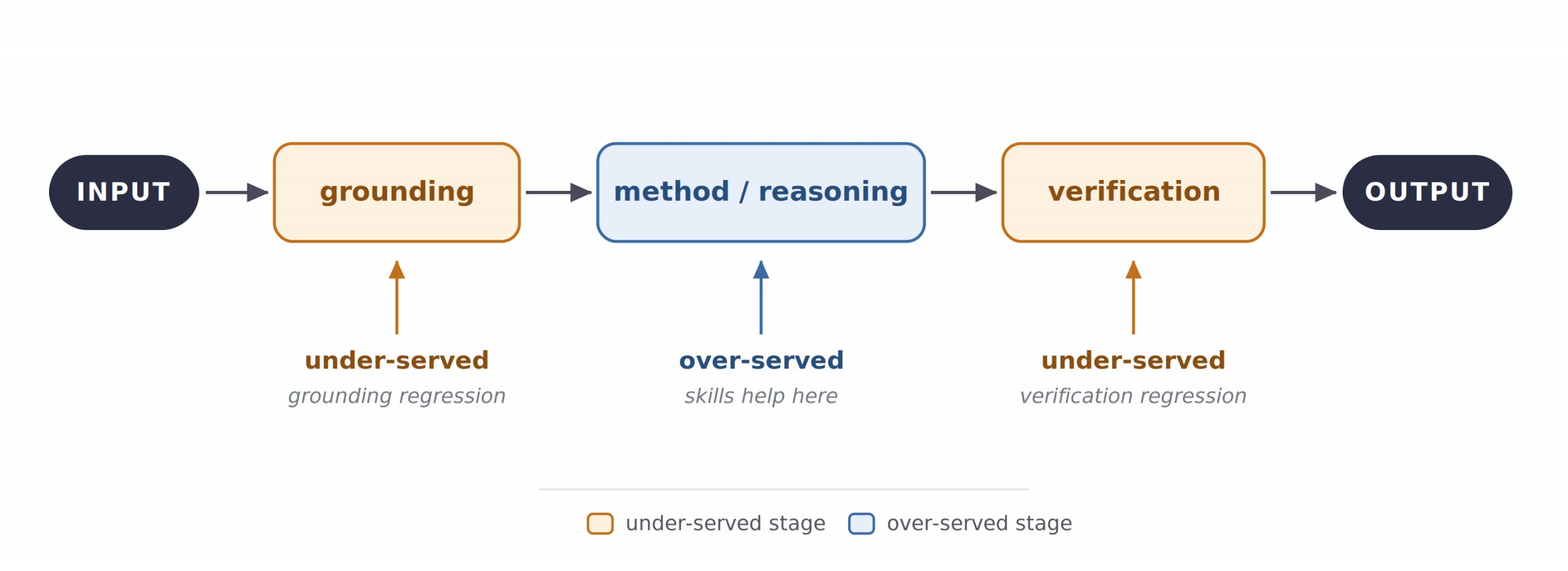
Tank and Nama ran nearly 6,000 agent executions across two office automation benchmarks and three model harness stacks, comparing agentic workflow performance with and without procedural skills. The core finding: aggregate “average improvement” metrics systematically mask a phenomenon they call regressions — tasks the agent solved without skills that it then fails after skills are added. The kicker is the ranking reversal: the best-performing skill configurations win not by gaining more successes, but by regressing less. They identify three mechanisms causing regressions. First, skill description osmosis: just having a skill in the context window alters agent behavior even when the skill is never actually invoked. Second, grounding displacement: the skill’s prescribed procedure overrides how the agent reads and interprets its inputs — a grounding problem, not a procedure problem. Third, verification displacement: the procedural script suppresses output checks the agent would have performed on its own. Their analysis of persistent failures (tasks that fail both with and without skills) shows existing skills are systematically over-indexed on procedural guidance — the stage least responsible for failures — while grounding and verification, the dominant failure sources, remain unsupported.
Cold read
This is two benchmarks in one narrow domain (office automation) with three harness stacks — that’s a reasonable sample for the hypothesis, but “office automation” is not “your agent.” The failure taxonomy (osmosis, grounding displacement, verification displacement) is descriptively useful but is reverse-engineered from traces, not confirmed through controlled ablations that isolate each cause independently. The claim that “many regressions are recoverable through better grounding and verification” is promising but the abstract gives no numbers on how many, or what “recoverable” costs in engineering terms. There’s also a benchmark contamination risk baked into any eval on widely-used office automation datasets — models may have seen task patterns during training, which could distort the regression/gain split. The paper’s prescription (decompose net effect into gains and regressions) is genuinely sensible methodology, but it doesn’t tell you how to build better skills, only how to measure them less badly.
What it means for you
- Signal maturity: 3/5 — Strong empirical framing, narrow domain, no fix yet shipped
- Who gets hurt: Any team running agentic AI in production who ships skills based on aggregate benchmark lifts — you are optimizing on a lying metric
- What breaks if this is true: Your skill library is a regression liability; every new skill you add is a silent bug injection into tasks that were already working, with no current eval catching it
- Why it might not land: The fix requires per-task decomposed evals, which are expensive and slow — most teams will continue to use aggregate scores because the alternative costs engineering cycles they don’t have
- Watch for: Eval frameworks (LangSmith, Braintrust, etc.) adding first-class “regression delta” metrics alongside aggregate task success — if that ships in the next two quarters, the industry has absorbed this finding
Forecast as of 2026-07-27
By Q2 2027, at least one major agent eval framework will ship a native gains/regressions decomposition view as a standard metric — but fewer than 30% of teams building production agents will have adopted decomposed skill evals over aggregate pass-rate, because the methodology cost exceeds the perceived urgency.
Source: The Regression Tax: Decomposing Why Skills Help and Hurt LLM Agents — Darshan Tank, Baran Nama. https://arxiv.org/abs/2607.22520v1