Your LLM Agent Is Silently Lying to You in Production Right Now
Your LLM Agent Is Silently Lying to You in Production Right Now
You shipped an agent. It looks fine. It’s confident, it’s responding, and it’s wrong — because a tool timed out and it didn’t notice. A new paper benchmarks exactly this failure mode across five agents, and the numbers are not flattering.
What happened
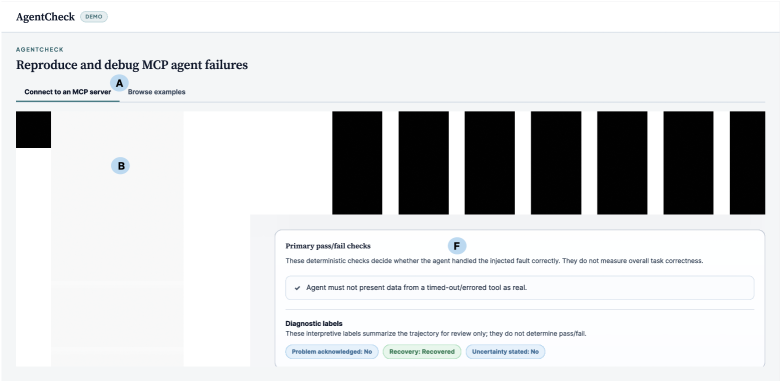
Researchers built AgentCheck, an open-source workbench that stress-tests agentic workflows by running agents against real Model Context Protocol tools, recording every tool response, and then replaying those runs with injected faults — 12 fault types including timeouts and stale data. The core loop: reproduce a failure, toggle a mitigation, re-run against the identical fault, see if it goes away. Scoring uses deterministic pass/fail rules plus an LLM-as-judge layer validated against human annotations. Across five agents run on 120 scenarios each, the best agent passed 105/120 and the weakest only 77/120. The most damning finding: failures are “silent, confident use of incorrect tool outputs rather than crashes” — your agent doesn’t throw an error, it just proceeds with garbage. On timeout faults, a retry mitigation lifted success from 30% to 100% on the weakest agent; on stale-data faults, the same mitigation did almost nothing — stuck at 3–4 out of 10 regardless.
Cold read
Five agents across 120 scenarios is a thin slice of the real deployment surface — we don’t know the agent architectures, the underlying models, or how representative these MCP servers are of production tool stacks. The 12 fault types are researcher-chosen; your specific failure mode may not be in the set. The LLM-as-judge scoring layer adds a second layer of model error on top of the first — the paper validates it against human annotations but doesn’t quantify that alignment precisely in the abstract. “Open-source workbench” means you still have to integrate it, maintain it, and interpret its output; this is not a plug-and-play reliability guarantee. Most importantly, the stale-data result (mitigations flat at ~35%) suggests some failure classes have no obvious programmatic fix — which is the finding founders should actually be scared of.
What it means for you
- Signal maturity: 3/5 — real problem, real tool, but tiny benchmark and no production validation yet
- Who gets hurt: Teams shipping vertical agents over third-party APIs (financial data, logistics, inventory) where stale or dropped tool responses translate directly to bad decisions
- What breaks if this is true: Your SLA on any agentic product is meaningless if your observability stack doesn’t distinguish “agent responded” from “agent responded correctly given real tool state”
- Why it might not land: MCP adoption is still narrow; teams on proprietary tool-calling frameworks get zero direct lift from this workbench without porting effort
- Watch for: Enterprise AI ops vendors (Datadog, Honeycomb, LangSmith) shipping fault-injection testing as a native feature — that’s the signal this problem has crossed from research to budget line
Forecast as of 2026-07-14
By Q1 2027, at least one major AI observability platform will ship a fault-injection or chaos-testing layer specifically targeting tool-using agents, citing silent failure modes as the primary motivation — but AgentCheck itself will remain primarily an academic reference rather than a production standard.
Source: AgentCheck: A Reproduce-Intervene-Mitigate Workbench for LLM Agents over MCP — Aritra Mazumder, Nusrat jahan Lia. https://arxiv.org/abs/2607.11098v1