
Your AI Agent Knew It Would Fail Before It Even Started
Your AI Agent Knew It Would Fail Before It Even Started
Every wasted compute cycle your agent burns on a doomed task is money you paid for a hallucination you could have killed in round one. A new paper says the model’s own guts knew it was lost before you did — and you can act on that signal automatically.
What happened
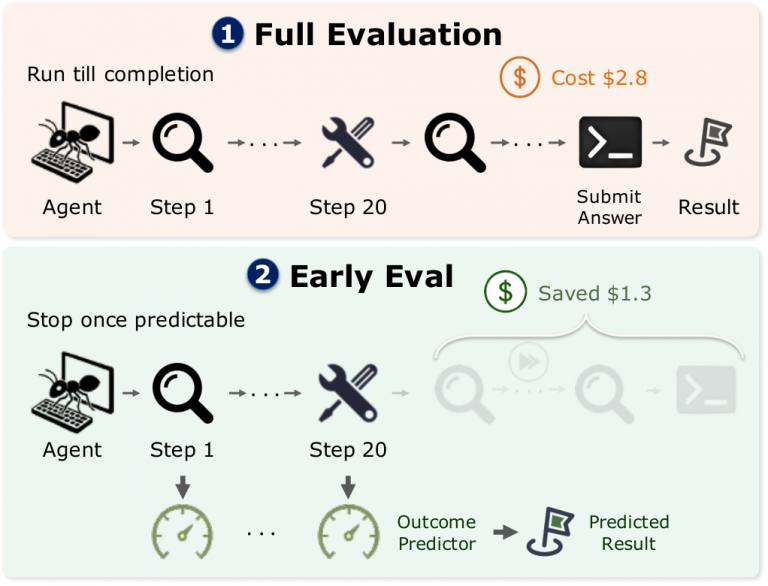
Researchers from multiple institutions built a system that reads an LLM agent’s internal hidden-layer activations — not its visible outputs — to predict whether a multi-step agentic workflow will eventually fail. The key finding: failure is predictable as early as round one of a multi-step episode, at a point when behavioral signals (what the agent actually says and does) are “barely better than chance.” They wrapped this signal into a “cascade” — a series of per-round kill-switches, each calibrated to let successful episodes survive at a user-specified rate. On the TextCraft benchmark with two models (Qwen-2.5-7B and Llama-3.2-3B), the cascade hit every recall target from 90% to 97%. At the 90% recall target — meaning 90% of eventually-successful episodes are allowed to complete — it saved 47.1% ± 10.3% of inference compute on Qwen and 37.2% ± 8.8% on Llama. A cascade reading only observable behavior saved roughly half as much, and adding behavioral signals on top of the hidden-state probe added nothing further.
Cold read
One benchmark. TextCraft is a controlled text-game environment, not a production customer-support pipeline, a coding agent, or a RAG-heavy research assistant. There is zero evidence this generalizes to open-domain or tool-heavy agents where failure modes are far more diverse. The probe reads hidden activations, which means you need white-box access to model internals — ruled out entirely if you’re calling a closed API like GPT-4o or Claude. The sample-complexity section is actually the most honest part of the paper: the authors explicitly tell you that high recall guarantees require data volumes your typical deployment may not have, which quietly undermines the “certifiable” framing in the headline. And “90% recall” sounds great until you remember that in a high-stakes agentic workflow, the 10% of good runs you kill are the ones your users remember.
What it means for you
- Signal maturity: 2/5 — Single benchmark, white-box only, no production validation
- Who gets hurt: Teams building compute-heavy autonomous agents on open-weight models (Llama, Qwen, Mistral stacks) who are bleeding GPU cost on failed long-horizon tasks
- What breaks if this is true: The economics of closed-model API agent products look significantly worse — you can’t access hidden states, so you can’t apply this optimization, and your open-weight competitors eat 40% lower inference costs
- Why it might not land: White-box activation access is a hard dependency. Anyone on a hosted API — which is most founders shipping today — cannot use this at all without a self-hosted inference stack
- Watch for: Whether inference providers (Together, Fireworks, Modal) or open-weight serving frameworks (vLLM, SGLang) ship a native “early abort” hook that exposes this at the infrastructure layer, removing the integration burden
Forecast as of 2026-07-08
By Q1 2027, at least one major open-weight inference-serving framework will ship an experimental early-abort or “confidence gate” feature citing activation-based failure prediction — but adoption will remain below 5% of agent deployments due to the white-box access requirement and calibration data burden.
Source: Doomed from the Start: Early Abort of LLM Agent Episodes via a Recall-Controlled Probe Cascade — Kai Ruan, Zihe Huang, Ziqi Zhou, Qianshan Wei, Xuan Wang, Hao Sun. https://arxiv.org/abs/2607.06503v1