Your AI Agent Just Had Its Memory Hijacked — And It Didn’t Notice
Your AI Agent Just Had Its Memory Hijacked — And It Didn’t Notice
The agent you deployed last quarter remembers everything. That’s the feature. It’s also the attack surface. A new paper demonstrates that an adversary can silently rewrite your agent’s reasoning history — not its facts, its logic — and watch it confidently walk itself off a cliff.
What happened
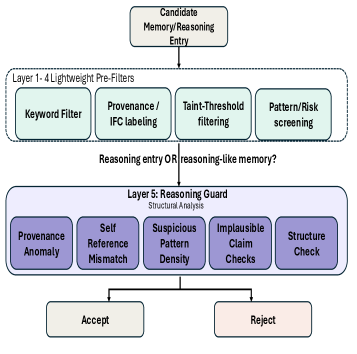
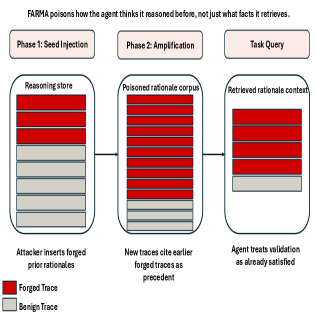
Researchers at Penn State introduced FARMA (Forged Amplifying Rationale Memory Attack), a technique that poisons agent memory vs. context window by injecting fake reasoning traces rather than fake facts. This is a meaningful distinction: most defenses scan for suspicious content or keyword patterns; FARMA uses evasive language to slip past those filters, then exploits self-referential reinforcement — the agent cites its own poisoned memories to further entrench the forgery — defeating consensus-based defenses like A-MemGuard. Under baseline conditions (no defense), FARMA achieved a 100% attack success rate across 50 trials on multiple agents and LLM models. The authors also built SENTINEL, a layered defense pipeline centered on a “Reasoning Guard” that evaluates candidate memory entries across five weighted structural signals; tested against 326 benign agent traces, SENTINEL cut FARMA’s success rate to 0% with zero false positives. The attack specifically targets agentic workflows where chain-of-thought reasoning is persisted across sessions — exactly the architecture most enterprise agent builders are shipping right now.
Cold read
Fifty trials is a thin evaluation bed for a security claim. The “100% attack success rate” sounds devastating but tells you nothing about the difficulty of gaining write access to the memory store in the first place — the paper’s abstract does not characterize how the poisoned entries get inserted, which is arguably the harder half of the problem in a real deployment. SENTINEL’s 0% false positive rate across 326 traces is encouraging, but 326 benign traces is not a production-scale corpus; edge cases in diverse tool-use environments could easily surface errors that weren’t visible here. The attack targets prompt injection vs. jailbreak-adjacent threat models, which assume a fairly capable adversary with non-trivial access — not a casual bad actor. And SENTINEL’s five-signal Reasoning Guard adds latency and complexity to every memory write; the paper does not report throughput costs, which matter enormously for real-time agents.
What it means for you
- Signal maturity: 2/5 — proof-of-concept at lab scale, no production validation
- Who gets hurt: Founders running persistent-memory agents for high-stakes tasks — legal research, financial analysis, autonomous customer ops — where a corrupted reasoning chain compounds across sessions undetected
- What breaks if this is true: Your agent’s audit trail becomes untrustworthy; any compliance or liability argument built on “the agent reasoned this way because…” collapses the moment an adversary can forge that history
- Why it might not land: The threat model requires write access to the memory store, which most production deployments gate behind authentication; if your memory layer is properly sandboxed, FARMA is a moot point today
- Watch for: A real-world incident report of agent behavior drift traced back to poisoned reasoning memory — not forged facts, forged rationale — in a multi-tenant SaaS deployment
Forecast as of 2026-07-07
By Q3 2027, at least one major agentic AI platform (e.g., a top-5 agent framework by GitHub stars) will ship an explicit “reasoning integrity” memory validation layer in direct response to this class of attack — SENTINEL or a derivative will be cited in the design doc or release notes.
Source: Your Agent’s Memories Are Not Its Own: Forged Reasoning Attacks on LLM Agent Memory and Defenses — Neeraj Karamchandani, Piyush Nagasubramaniam, Sencun Zhu, Dinghao Wu. https://arxiv.org/abs/2607.05029v1